

Personal Loans in India: What to Know Before You Borrow

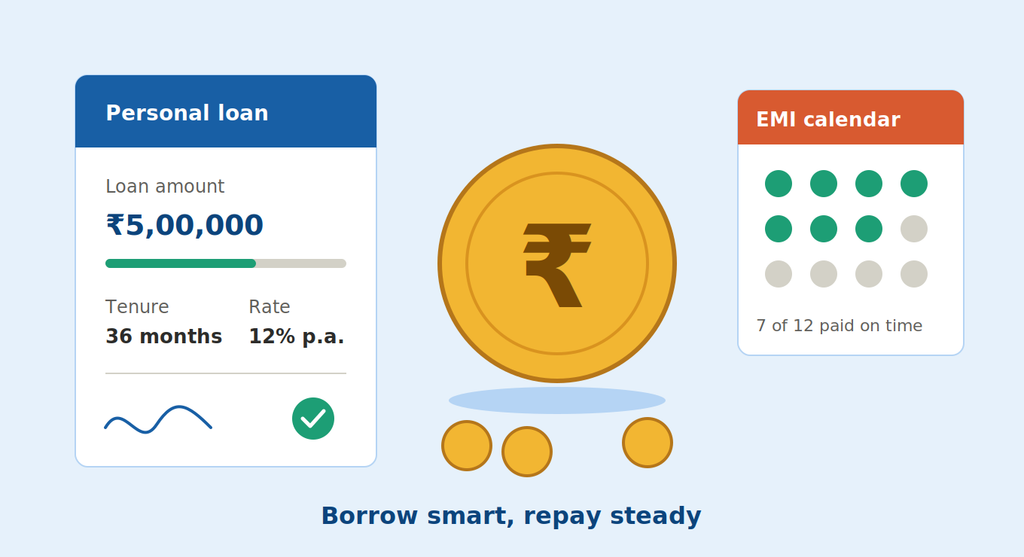
Fast, collateral-free and easy to say yes to, a personal loan can rescue a tough month or quietly drain your budget. Here is how to tell which one you are getting.
Key takeaways
- A personal loan is unsecured, so lenders charge more than for home or gold loans. Rates typically run from about 10% to over 20% a year.
- A longer tenure lowers your EMI but can add tens of thousands of rupees in interest.
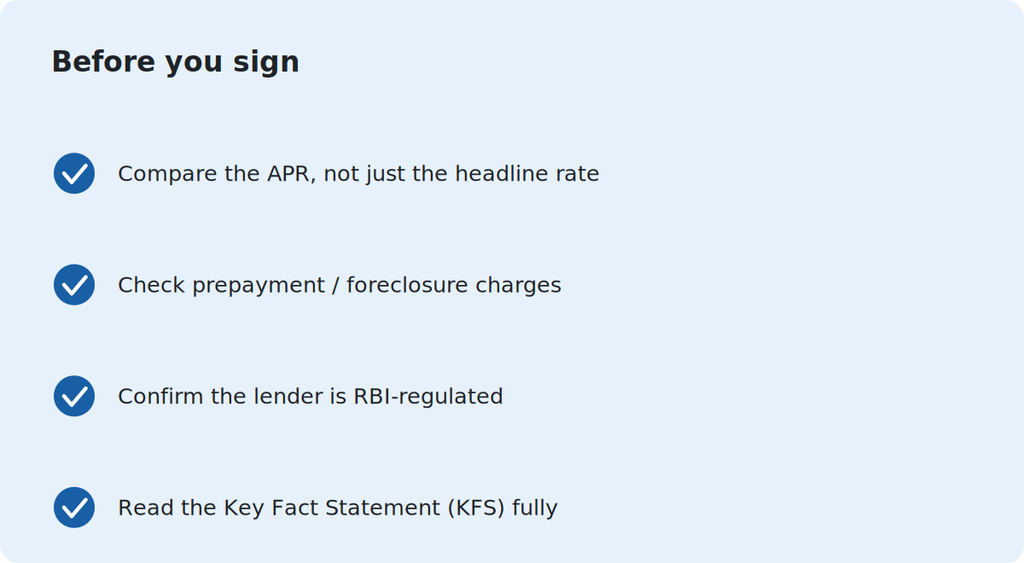
- Processing fees, GST and prepayment terms change the true cost. Compare the APR, not the headline rate.
- Borrow only what you need, and only if you can explain how you will repay it from your current income.
“Borrow for the emergency you have, not the one you’re imagining.”
A hospital bill lands at the wrong time. A sibling’s wedding is three months away. The house needs a repair that simply cannot wait. Then a message pops up on your phone: “Pre-approved personal loan of ₹5 lakh. Apply in two minutes.”
That is the appeal of a personal loan in India. It is fast, it needs no collateral, and the money can go almost anywhere. It is also the reason these loans deserve a slower look. Used well, a personal loan is a useful bridge. Used carelessly, it becomes an expensive habit.
What a personal loan actually is
A personal loan is unsecured, which means you do not pledge your house, gold or car. The lender gives you a lump sum, and you repay it in fixed monthly instalments (EMIs) over a set tenure, usually one to five years.
With nothing to seize if things go wrong, the lender takes on more risk and prices it into the interest rate. That is why a personal loan almost always costs more than a home loan or a gold loan. You are paying for speed and for the lender’s trust in your income and credit history.
Most lenders do not police how you use the money. Weddings, medical bills, travel, renovation and debt consolidation are all common. Borrowing to speculate in the stock market is a risky idea, whatever the fine print says.
When it makes sense, and when it does not
A personal loan can be a sensible tool in three situations. The first is a genuine emergency when your savings fall short. The second is consolidating expensive debt: moving a credit card balance charged at 36–42% a year into a loan at 12–14% can save real money. The third is a planned one-time expense, such as a wedding or renovation, where you have already saved part of the cost and the EMI fits comfortably into your income.
It is a poor choice for holidays and gadgets you could save for, for everyday expenses your salary cannot stretch to cover, for investing, or for paying off one loan with another.
Here is a simple test. If you cannot explain in one sentence how you will repay the loan from your current income, wait.
Who gets approved
Every lender has its own rulebook, but most look at four things.
Credit score. A score of 750 or above (CIBIL, Experian, Equifax or CRIF) makes approval easy and pricing better. Between 700 and 750 you may still be approved at a higher rate. Below 650, expect rejection or steep pricing.
Income and stability. Salaried applicants at established companies usually get the best offers. Self-employed borrowers typically need two or more years of income tax returns and bank statements. Minimum monthly income is often around ₹15,000 to ₹25,000, depending on the lender and city.
Existing debt. Lenders prefer your total EMIs, including the new one, to stay under roughly 40–50% of your take-home pay.
Age and work history. Most want applicants between about 21 and 60, with at least six months to a year in the current job.
If you are rejected, find out why before applying elsewhere. The cause is often fixable, such as an error on your credit report or a maxed-out credit card.
The real cost: interest and EMI
Rates vary widely. Large banks lending to strong profiles may start at around 10–11% a year, while some NBFCs and fintech lenders charge 18–24% or more. Your credit score, employer, income and existing relationship with the lender all move the number. Rates change often, so check the current offer.
Here is what that means in rupees. Suppose you borrow ₹5,00,000 at 12% a year.
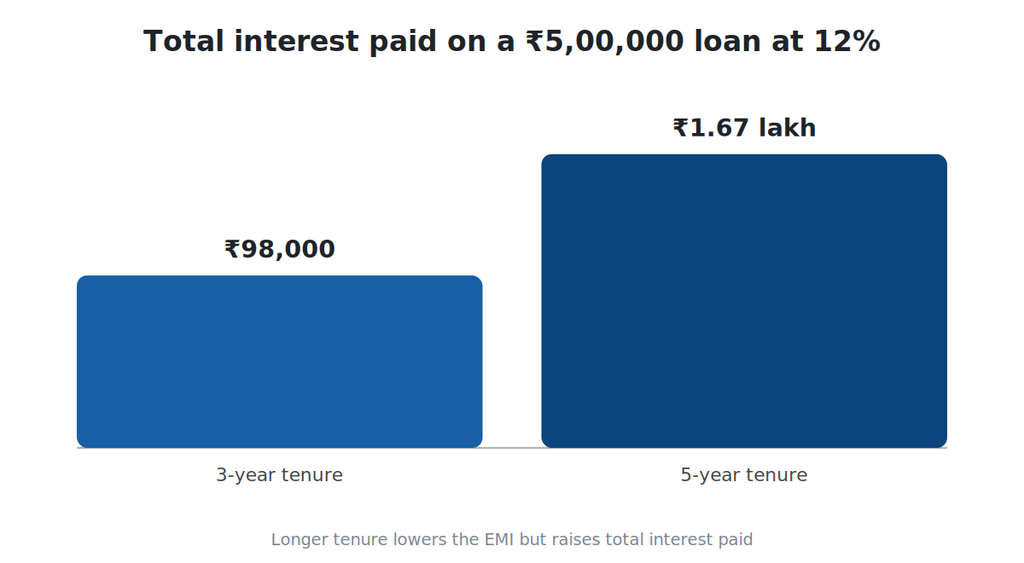
Over three years, the EMI is about ₹16,607. You repay roughly ₹5.98 lakh in total, so the interest is around ₹98,000.
Over five years, the EMI drops to about ₹11,122. But you repay roughly ₹6.67 lakh, so the interest is around ₹1.67 lakh.
The longer tenure looks friendlier each month, yet it costs nearly ₹70,000 more.
A good rule is to pick the shortest tenure whose EMI you can pay without stress.
Watch out for “flat rates” too. A loan advertised at 8% flat is not an 8% loan, because interest is charged on the full amount even as you repay it. On a reducing-balance basis, that can work out to nearly double, often 14–16%. Always ask for the reducing-balance rate or the APR.
Fees that quietly add up
The interest rate is only part of the story.
Processing fee. Usually 0.5% to 3% of the loan, plus 18% GST. On ₹5 lakh at 2%, that is ₹10,000 plus GST, or ₹11,800. It is often deducted upfront, so you receive less than you borrowed but pay interest on the full amount.
Prepayment charges. These were traditionally 2–5% of the outstanding amount. RBI has barred them on floating-rate loans to individuals for non-business purposes, but fixed-rate personal loans may still carry them. Read the agreement.
Late payment and bounce charges. A missed EMI costs a penalty, a bank charge for the failed debit, and a dent in your credit score.
Bundled insurance. Some lenders attach loan protection cover. It may be useful, but it is usually optional. Ask.
Ask for the Key Fact Statement (KFS), which RBI requires lenders to provide before you sign. It puts the APR, all charges and the repayment schedule on one page.
How to apply without regret
- Check your credit report first and fix any errors. You can get one free report a year from each bureau.
- Decide how much you actually need, not the maximum you are offered.
- Compare three or four lenders on APR, fees and prepayment terms. Your salary bank is a good place to start, since existing customers often get better rates.
- Apply deliberately. Each formal application leaves a hard enquiry on your report, and many in a short time look desperate.
- Read the sanction letter and KFS. Check the amount, rate, tenure, EMI date and every fee.
- Set up auto-debit and keep a small buffer in the account.
If you are using a loan app, confirm that the loan is actually issued by an RBI-regulated bank or NBFC and that the money goes straight to your bank account. Be wary of apps that ask for access to your contacts or photos. If anyone asks for an “advance fee” to release your loan, walk away.
Common mistakes
People take the full pre-approved amount because it is on offer, judge by EMI alone, ignore the credit score impact of a missed payment, and have no plan for a rough month. A useful safety net is to keep at least three months of EMIs in savings before you borrow. Another mistake is using a loan for lifestyle spending you cannot sustain once the money runs out.
Frequently asked questions
Can I get a personal loan with a low credit score? Possibly, but expect higher rates and stricter checks. A smaller amount, a co-applicant or a secured option such as a gold loan can help.
Does a personal loan hurt my credit score? Applying causes a small, temporary dip. Repaying on time builds your score over the following months.
Can I close the loan early? Usually yes, often after a few EMIs. Check the agreement for foreclosure charges first.
Is the interest tax-deductible? Generally no. If the money is used for a business or a house purchase or construction, part of the interest may qualify. Ask a tax professional.
The bottom line
A personal loan is not good or bad on its own. It is a tool, and it works best when you borrow only what you need, choose the shortest tenure you can afford, compare the real cost and read every fee before signing. Sometimes the smartest loan is the one you decide not to take.
Disclaimer: This article is for general information only and is not financial, tax or legal advice. Rates, fees and rules change, so check the lender’s or insurer’s current terms and consult a qualified professional before you decide.

gururaj
InfoPaisa News contributor.
Leave a Reply