

Gold Loans in India: Quick Cash Against Your Jewellery, Explained
In many Indian families, gold is not just jewellery. It is savings thathas been built up over years. A gold loan lets you use that assetwithout selling it, but the convenience comes with a…

In many Indian families, gold is not just jewellery. It is savings that
has been built up over years. A gold loan lets you use that asset
without selling it, but the convenience comes with a responsibility: you
need to understand exactly what you are pledging and what happens if you
cannot repay.
Key takeaways
- A gold loan is secured against jewellery or coins, so approval is
quick and your credit score matters less. - RBI caps how much you can borrow against your gold’s value,
generally 75% to 85% depending on loan size. Check the current limit
with your lender. - Only the pure gold content is valued. Stones, wastage and making
charges are not counted. - Compare the whole cost: interest rate, processing fee, valuation
charges and how the loan is repaid.
“Your gold is security, not spare cash. Treat the loan as a bridge,
not a windfall.”
In many Indian homes, gold is more than jewellery. It is a family
reserve, built up through weddings, festivals and years of careful
buying. So when money is tight, it is natural to wonder whether that
reserve can help without being sold.
A gold loan says yes. You pledge your gold, get cash quickly and take
your ornaments back when you repay. It is one of the fastest and
cheapest forms of borrowing, but only if you know the rules of the game.
What a gold loan is
You hand your gold to a lender, who values it, keeps it in a secure
vault and gives you a loan against it. When you repay the loan with
interest, you get the gold back.
Banks, NBFCs and cooperative banks all offer gold loans. Lenders
generally accept ornaments and certain gold coins. Bullion bars are
often not accepted. Because the gold itself is the security, lenders do
not depend heavily on your income or credit score, which is why approval
can take under an hour.
How much can you borrow
The lender weighs the gold, tests its purity and multiplies the pure
gold weight by the day’s gold price. Stones, enamel and other non-gold
parts are excluded, and making charges are ignored. That is why a heavy,
ornate necklace may be worth less as security than you expect.
Hallmarked jewellery with a clear purity mark is often quicker to
assess.
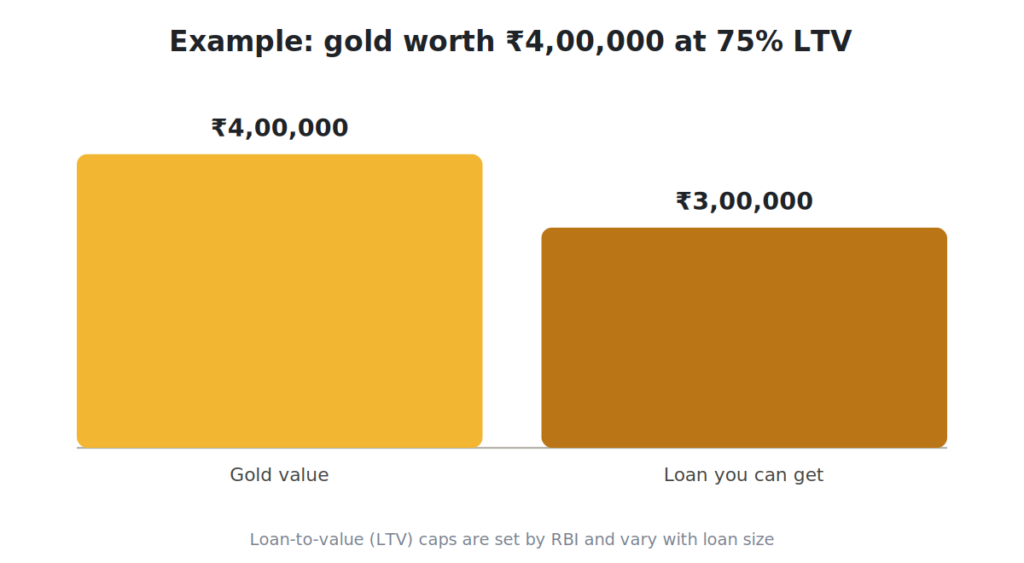
You then get a percentage of that value, called the loan-to-value (LTV)
ratio. RBI sets a ceiling, generally 75% to 85% depending on the loan
size. For illustration, if your pledged gold is valued at ₹4,00,000 and
the LTV is 75%, you can borrow up to ₹3,00,000. Many lenders offer
slightly less, so ask what they will give.
Interest rates and repayment options
Rates vary widely, from roughly 9% at some banks to 24% or more at some
NBFCs. Ask for the annual rate and how it is calculated. Most gold loans
charge interest on a reducing balance or daily basis.
Repayment often comes in one of three forms:
- Regular EMI. Principal and interest are paid together every month
over the tenure. - Interest-only. You pay the interest monthly and repay the principal
at the end. - Bullet repayment. You pay everything, principal and interest, in one
go at the end. RBI norms generally require such loans to be closed
within 12 months.
To see the cost, take ₹3,00,000 at 11% a year. Paying interest only
would cost about ₹2,750 a month. The interest-only route keeps monthly
outflow low, but the ₹3 lakh is still due at the end, so plan for it
from day one.
Costs beyond the rate
- Processing fee. Often 0.25% to 2% of the loan, plus GST.
- Valuation or appraisal charges. Some lenders charge for testing your
gold. - Insurance and storage. Usually included, but confirm that your gold
is insured in the vault. - Late payment charges. Extra interest or penalties if you miss a
payment. - Foreclosure charges. Some lenders charge a fee for early closure.
Why people choose gold loans
Speed is the main draw. Documentation is light, and funds can arrive
within hours. Rates are often lower than for personal loans or credit
card debt, because the loan is secured. You can often part-pay and get
some ornaments back, and there is generally no long approval wait. For a
short-term cash need, few products are as convenient.
The risks to understand
The biggest risk is simple: if you do not repay, you can lose your gold.
Lenders must send notice before an auction and follow set procedures,
but the outcome is still the loss of an asset that may have sentimental
value.
Falling gold prices are another risk. If the price drops sharply and
your loan is close to the maximum LTV, the lender may ask you to pay
part of the loan or top up the security. There is also the question of
safety, so ask how your gold is stored and insured. Finally, watch out
for informal lenders and doorstep operators who charge very high rates
or add hidden charges. Stick to banks and RBI-registered NBFCs.
How to take a gold loan safely
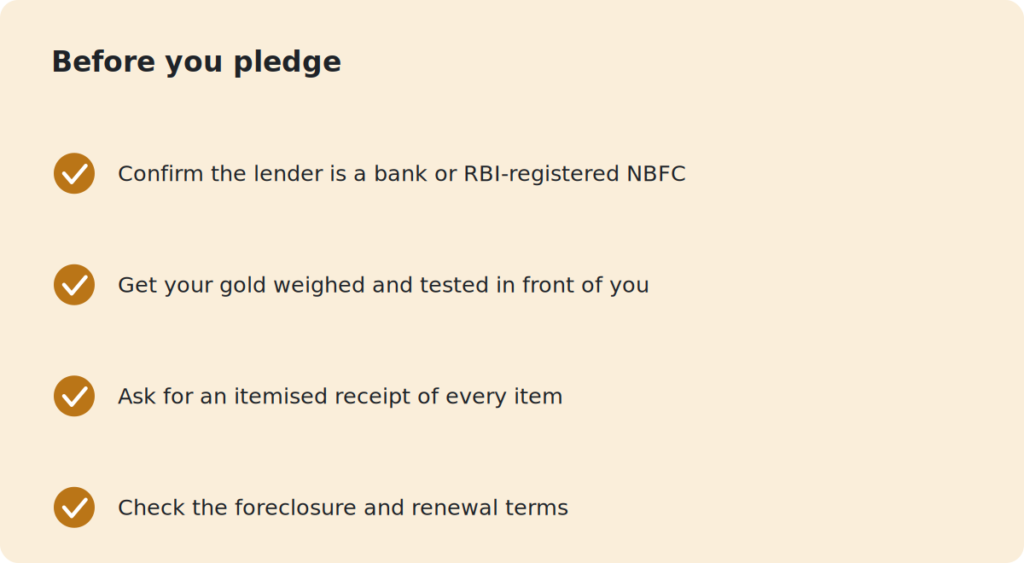
- Compare lenders. Check the interest rate, processing fee and
foreclosure terms at two or three banks or NBFCs. - Confirm the lender is regulated. Look for a bank or an NBFC
registered with RBI. - Watch the valuation. Ask for the gold to be weighed and tested in
front of you. - Get an itemised receipt. It should list each item, weight and
purity. - Read the terms. Pay special attention to the repayment schedule,
penalty charges and what happens on default. - Set reminders. Note the due date for interest or repayment, and pay
a little early. - Check your gold on return. Verify weight and items against your
receipt, and keep the loan-closure receipt.
Gold loan or personal loan?
If you have gold you are willing to pledge, a gold loan is often cheaper
and quicker than a personal loan, and it does not need a strong credit
score. The trade-off is the risk to the gold itself. A personal loan is
unsecured, so the worst outcome of a default is damage to your credit
record and recovery action, not the loss of family jewellery.
Ask yourself three questions. Can I repay within the tenure? Would
losing this gold hurt more than paying a higher personal loan rate? Is
the amount small enough that a smaller pledge would do? If the answers
are yes, no and yes, a gold loan is probably the better fit.
When to avoid a gold loan
Skip it if you have no clear plan to repay, if the amount is more than
you can service, or if the ornaments are irreplaceable heirlooms. Do not
borrow against gold to fund speculation or lifestyle spending. If your
need is small and short, a smaller loan against a smaller piece of
jewellery is a better choice than pledging everything.
Frequently asked questions
Do I need a good credit score for a gold loan? Usually it is not the
deciding factor, since the gold is the security. Missed payments can
still hurt your record, depending on what the lender reports.
Can I get part of my gold back after part payment? Many lenders allow
this. Ask before you take the loan.
Can I pledge gold I received as a gift or inherited? Yes, but lenders
may ask for a declaration of ownership, and for large quantities they
may want purchase bills or other proof.
What if I cannot repay on time? Speak to the lender early. Some allow
renewal or restructuring. If the loan stays unpaid, the lender can
auction the gold after giving notice.
Key takeaways
A gold loan can be one of the most practical ways to raise money
quickly. It works better as a short-term bridge with a clear repayment
plan, taken from a regulated lender after comparing the total cost.
Treat your gold as security you plan to reclaim, not as free cash, and
it will do its job without leaving you with regrets.
Editorial note: Rates, fees, tax rules and regulatory requirements can
change. Check the current terms that apply to you before acting.
Disclaimer: This article is for general information only and is not
financial, tax or legal advice. Rates, fees and rules change, so check
the lender’s or insurer’s current terms and consult a qualified
professional before you decide.
 Life Insurance
 in India: Why Term Plans Come First
 Mutual Funds
 in India: A Beginner’s Guide to Investing Through SIPs
 Bike Insurance
 in India: What Every Two-Wheeler Owner Should Know
 Business Loan
s in India: How Small Businesses Can Borrow Smartly
 Home Loan
s in India: A Buyer’s Guide to Rates, EMIs and Hidden Costs
 Chit Fund
s in India: How They Work and How to Stay Safe
 Health Insurance
 in India: A Practical Guide to Choosing the Right Policy
 Credit Cards
Comments