

Credit Cards in India: How to Use Them Without Getting Burned
Ask ten people about credit cards and you will probably get tendifferent stories. One person is collecting reward points; another isstill paying for a purchase made months ago. The card is the same. Theoutcome…

Ask ten people about credit cards and you will probably get ten
different stories. One person is collecting reward points; another is
still paying for a purchase made months ago. The card is the same. The
outcome depends largely on how you use it.
Key takeaways
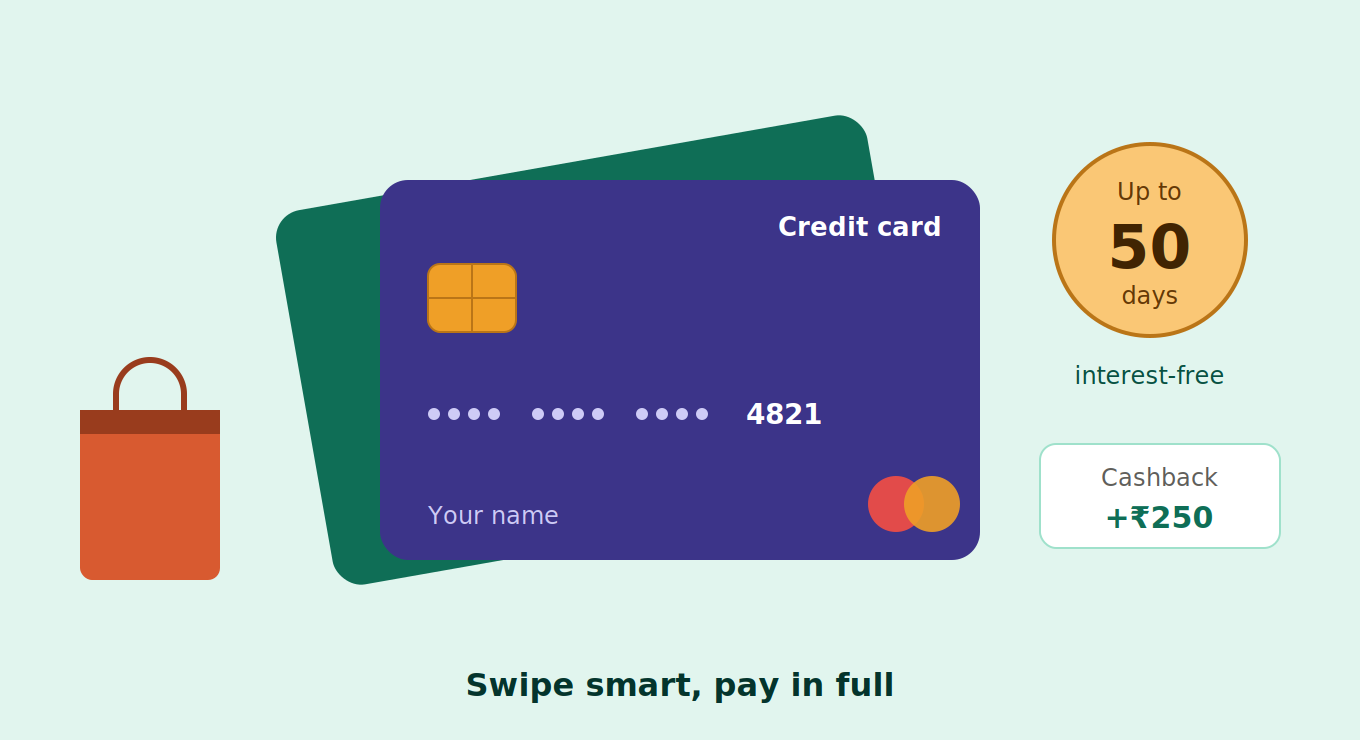
- A credit card gives up to about 45–50 days of interest-free credit,
but only if you pay the full bill by the due date. - Paying only the minimum due costs roughly 3–4% a month (36–48% a
year) on the balance. - Pick a card by your own spending, and check that its fee is smaller
than the value you will really get back. - Keep your utilisation under about 30% of your limit to protect your
credit score.
“A credit card is free credit for the disciplined and expensive credit
for everyone else.”
Ask ten people about credit cards and you will hear ten different
stories. One friend flies on reward points. Another is still paying off
a phone bought three Diwalis ago. Same piece of plastic, very different
outcomes.
The difference is not luck. It comes down to understanding a few rules
that are simpler than the marketing makes them sound.
How a credit card really works
A credit card is a short-term loan from the bank with a built-in grace
period. You spend now, get a statement at the end of the billing cycle,
and pay by the due date. Pay in full and you owe no interest at all.
The grace period is often up to 45–50 days, but how much you get depends
on when you swipe. Say your statement is generated on the 5th and
payment is due on the 25th. A purchase on the 6th appears on next
month’s statement, giving you nearly 50 days. A purchase on the 5th
appears on this month’s statement, giving you just 20.
So a small habit pays off: put big purchases right after your statement
date. You will find both dates printed on every bill.
The minimum due trap
Every statement shows two numbers. The total amount due is everything
you owe. The minimum amount due, often about 5% of the bill, just keeps
your account in good standing.
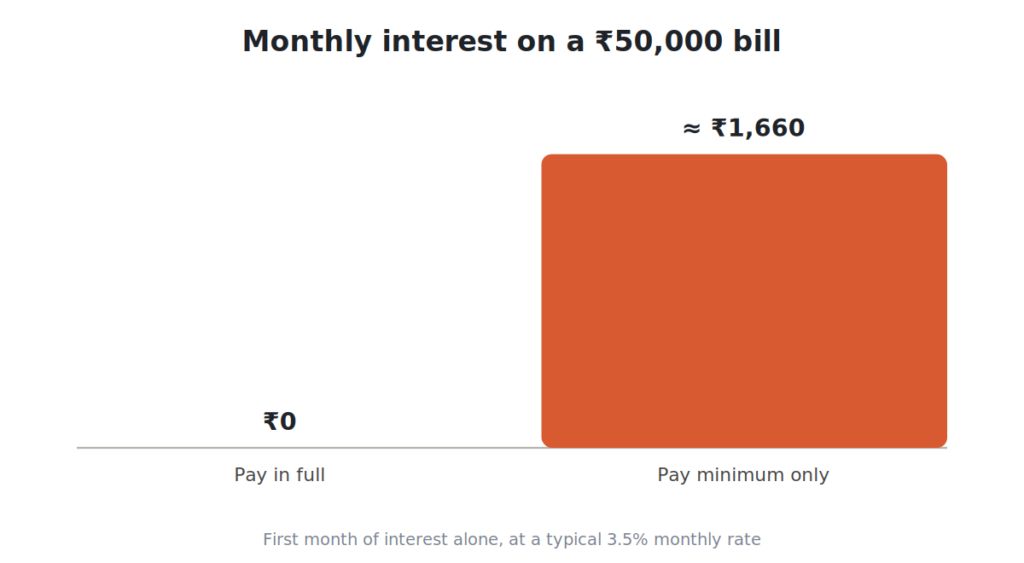
Paying the minimum feels like relief, but it is not. On a ₹50,000 bill
you would pay about ₹2,500, and the remaining ₹47,500 starts attracting
interest of often 3–4% a month. At 3.5% that is about ₹1,660 in the
first month alone.
You also lose the interest-free period on new purchases.
Keep that up for a few months and most of your payment goes to interest
instead of the original spend. The rule is simple: pay the total due,
every month. If you truly cannot, pay as much as you can and ask your
bank about converting the big purchase into an EMI, which often costs
around 13–18%. A personal loan may also be cheaper than carrying a card
balance.
The main types of cards
- Lifetime-free or entry-level. No annual fee and basic rewards. A
good first card, especially for building a credit history. - Cashback cards. A percentage of your spending comes back, often on
categories like online shopping or bills. - Rewards cards. You earn points and redeem them for vouchers,
products or statement credit. A point’s value varies a lot from card
to card. - Travel cards. Miles, lounge access and forex benefits. They make
sense only if you travel often. - Fuel and co-branded cards. Strong returns on one category or brand,
ordinary elsewhere. - Premium cards. Richer perks, higher fees and much higher income
requirements. - Secured cards. Issued against a fixed deposit, often with little or
no income proof. A good route if you are new to credit or
rebuilding.
How to choose one
Most people do it backwards: they see a welcome offer and apply. Try
this instead.
Start with your spending. Look at two or three months of bank statements
and note your top three categories, such as groceries, fuel, online
shopping, bills or travel. Pick a card that rewards those.
Do the maths on the fee. A card charging ₹1,000 a year must return more
than ₹1,000 in value. Fee waivers on annual spend are useful only if you
would spend that much anyway. Never spend extra just to earn a waiver.
Compare the effective return, not the headline. A card offering 5% but
capped at ₹100 a month can lose to a flat 1.5% with no cap if you spend
a lot.
Ignore the welcome gift. The card will be in your wallet for years, so
its ongoing terms matter far more.
RBI now lets you choose your card network (Visa, Mastercard, RuPay and
others) when you apply, in most cases. If you like paying through UPI, a
RuPay credit card can be linked to it.
Rewards: read the small print
Points are not rupees. One card’s 100 points may be worth ₹25, another’s
₹100, so always check the redemption value. Many cards exclude or cap
rewards on fuel, rent, insurance, wallet top-ups, gold and utility
bills. Some cap monthly cashback or let points expire after a few years.
The better reward is the one you actually use. A simple cashback card
you understand beats a complicated points card you keep forgetting to
redeem.
Fees and charges to watch
- Joining and annual fee. Anything from zero to several thousand
rupees, plus 18% GST. - Interest on unpaid balances. Around 3–4% a month.
- Late payment fee. Usually a few hundred rupees, rising with the
amount outstanding. It also hurts your credit score. - Cash advance fee. Withdrawing cash often costs 2.5–3% of the amount,
and interest starts from day one with no grace period. Avoid it
unless it is a real emergency. - Foreign currency markup. Typically 2–3.5% plus GST on international
spends. - EMI processing and over-limit fees. Check these before you opt in.
Your bank must give you a summary of the most important terms and
conditions. It is short, and it lists the charges in one place.
Eligibility and your credit score
Lenders generally look at age (often 21 to 60 for the main cardholder),
income (entry-level cards often start at ₹15,000–₹25,000 a month,
depending on bank and city), credit score (750 or above gives the most
choice) and job or business stability. If you have no history, a secured
card against a fixed deposit is a good way in.
Your card also shapes your credit profile. Keep utilisation to about 30%
of your limit, so a ₹1,00,000 limit is happiest with around ₹30,000 of
monthly spending. Avoid applying for several cards at once, since each
application creates a hard enquiry. And think twice before closing your
oldest card: a long history helps your score.
Habits of people who win with cards
- They set up auto-debit for the total amount due, so a due date never
sneaks up on them. - They keep one or two cards they understand well, not a drawer full.
- They turn on transaction alerts, so every swipe pings their phone.
- They read the statement each month and check for transactions they
do not recognise. - They protect the card: no sharing of OTP, CVV or PIN, and they use
the controls in their banking app to switch off online,
international or contactless use when they do not need it.
Frequently asked questions
How many credit cards should I have? For most people, one to three is
plenty. Add another only if it fills a real gap.
Does using a card improve my credit score? Yes, if you pay in full and
on time and keep utilisation low. Missed payments do the opposite.
How do I close a card? Clear your dues and ask your bank to close it.
RBI rules require the issuer to close it within seven working days once
you have cleared what you owe. Keep the confirmation in writing.
What if my card is lost or stolen? Block it immediately through your
banking app or helpline, and report any transactions you did not make
right away.
Key takeaways
A credit card is not free money, and it is not a trap either. It is a
tool that rewards discipline. Pay the full bill on time, use only part
of your limit, and choose a card that fits how you really spend. Do that
and you get free short-term credit plus rewards on top.
If you have already fallen behind, it is fixable. Stop the new spending,
pay the balance down as fast as you can, and ask your bank about a
lower-cost EMI.
Editorial note: Rates, fees, tax rules and regulatory requirements can
change. Check the current terms that apply to you before acting.
Disclaimer: This article is for general information only and is not
financial, tax or legal advice. Rates, fees and rules change, so check
the lender’s or insurer’s current terms and consult a qualified
professional before you decide.
 Life Insurance
 in India: Why Term Plans Come First
 Mutual Funds
 in India: A Beginner’s Guide to Investing Through SIPs
 Bike Insurance
 in India: What Every Two-Wheeler Owner Should Know
 Business Loan
s in India: How Small Businesses Can Borrow Smartly
 Home Loan
s in India: A Buyer’s Guide to Rates, EMIs and Hidden Costs
 Chit Fund
s in India: How They Work and How to Stay Safe
 Gold Loan
s in India: Quick Cash Against Your Jewellery, Explained
 Health Insurance
Comments