

Bike Insurance in India: What Every Two-Wheeler Owner Should Know
ces between third-party, comprehensive and add-on cover becomeimportant. Key takeaways Third-party insurance is mandatory under the Motor Vehicles Act. Itcovers damage or injury you cause to others, but not your own bike. Comprehensive insurance…

ces between third-party, comprehensive and add-on cover become
important.
Key takeaways
- Third-party insurance is mandatory under the Motor Vehicles Act. It
covers damage or injury you cause to others, but not your own bike. - Comprehensive insurance adds own-damage cover, and standalone
own-damage policies are available if you already hold a separate
third-party policy. - Your premium depends on the Insured Declared Value (IDV), engine
capacity, age, location and add-ons. Do not choose the lowest IDV
just to save on premium. - Renew before expiry. A lapse can cost you your no-claim bonus and
trigger an inspection.
“Third-party cover protects the law. Comprehensive cover protects your
bike.”
India has hundreds of millions of two-wheelers on its roads, and the
rider is the most exposed person in any accident. That is one reason
insurance matters. Another is the law: riding without at least
third-party insurance can bring a fine and even imprisonment. But a
cheap policy that does not cover you when your bike is stolen or damaged
is not much comfort either.
Why bike insurance is compulsory
The Motor Vehicles Act requires every vehicle on the road to have at
least third-party liability insurance. This covers the legal liability
you have if your bike injures or kills someone or damages their
property. Without valid insurance, a first offence can attract a fine of
₹2,000 and possibly imprisonment, with higher penalties for repeat
offences. More importantly, you would be personally liable for any
compensation a court orders.
Types of two-wheeler policies
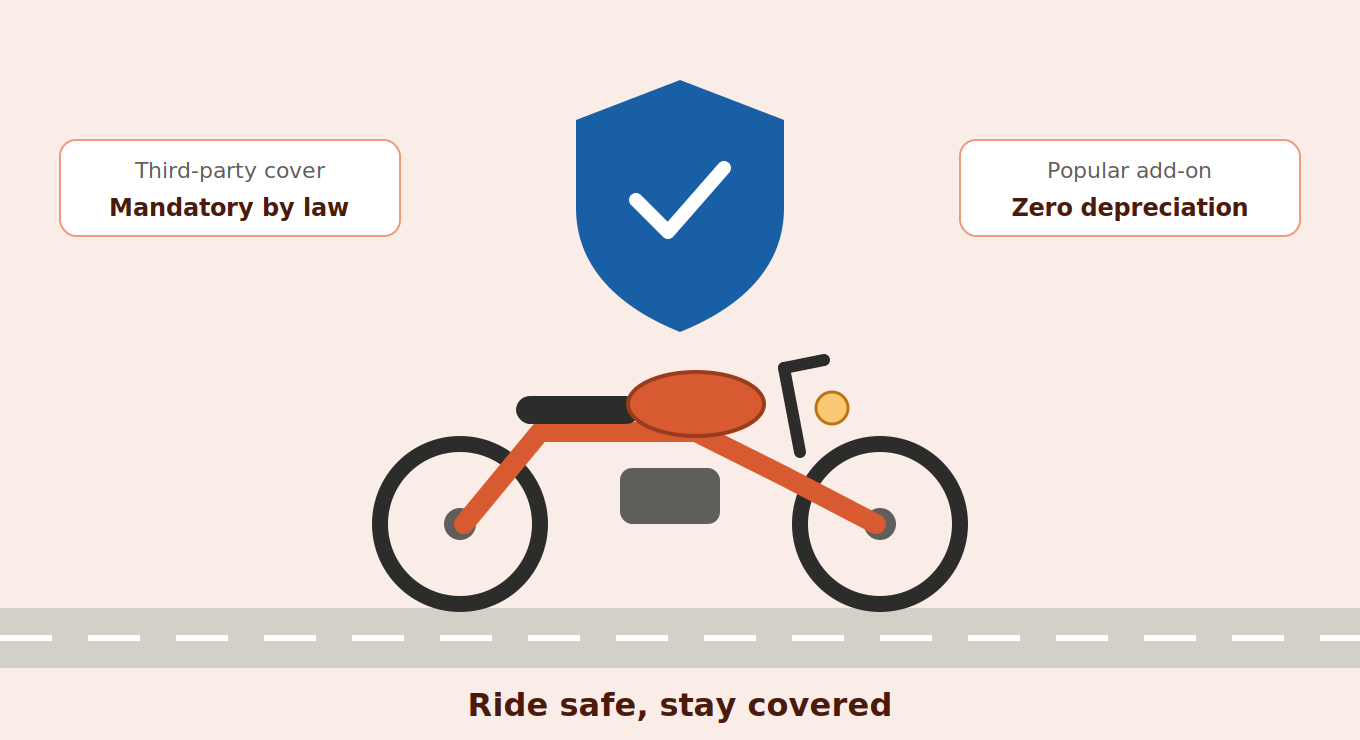
Third-party only. The legal minimum. It pays for injury, death or
property damage you cause to others. It does not pay for damage to your
own bike or for theft. The premium for this cover is set by the
insurance regulator, IRDAI, and varies with engine capacity.
Comprehensive. Combines third-party cover with own-damage cover. It
often covers accidents, fire, theft, natural disasters like floods and
earthquakes, and man-made events like riots. It costs more, but it is
what protects your own investment.
Standalone own-damage. For riders who already hold a valid long-term
third-party policy and want to add own-damage cover separately.
Personal accident cover. Owner-drivers are required to have a personal
accident cover, currently ₹15 lakh, that pays out in case of death or
permanent disability from an accident. It is often built into the
policy.
Many new bikes are sold with long-term packages, including multi-year
third-party cover. Check your invoice so you know exactly what you
already have.
What decides your premium
- Insured Declared Value (IDV). This is the maximum amount the insurer
will pay if your bike is stolen or damaged beyond repair. It is
based on the manufacturer’s listed price minus depreciation for the
bike’s age. A higher IDV means a higher premium and a higher payout. - Engine capacity. Bigger engines cost more to insure.
- Age of the bike. Older bikes have lower IDV and often lower
premiums, but repairs may cost more relative to value. - Location. Cities with more theft or traffic may cost more.
- Add-ons. Each add-on raises the premium.
- No-claim bonus. A discount on the own-damage premium for every
claim-free year. - Voluntary deductible. Agreeing to pay a small amount yourself on
each claim can lower the premium.
No-claim bonus explained
If you do not make a claim during the policy year, you earn a no-claim
bonus (NCB) on the own-damage premium. It often starts at around 20% and
can climb to 50% after several claim-free years. The NCB belongs to you,
not the bike, so you can carry it over to a new policy or a new bike.
Small claims can wipe out a year’s bonus, so for minor scratches, paying
yourself may be smarter than claiming.
Keep policies continuous. NCB is generally protected only if you renew
within a limited period after expiry, often 90 days. Beyond that, you
may lose it.
Add-ons worth considering
- Zero depreciation. Pays the full cost of replaced parts without
deducting depreciation. Useful for newer bikes. - Engine protection. Covers engine damage from water ingress or oil
leakage, which standard policies often exclude. - Consumables cover. Pays for items like nuts, bolts, oil and grease
used in repairs. - Roadside assistance. Towing and minor on-the-spot repairs.
- Return to invoice. If the bike is stolen or declared a total loss,
this pays the original invoice value rather than the depreciated
IDV.
Choose add-ons based on your bike’s age, where you ride and your budget.
An eight-year-old commuter bike probably does not need every add-on.
How to buy or renew
- Check your current policy. Note the expiry date and what it covers.
- Compare quotes. Look at premium, IDV, add-ons and the insurer’s
claim record. - Set a fair IDV. Do not pick a very low value just to reduce the
premium. It reduces your payout too. - Disclose accurately. Provide correct details about the bike, past
claims and modifications. - Renew before expiry. A lapse can mean an inspection and losing your
NCB. Note that some insurers and states also ask for a valid
pollution-under-control certificate. - Keep digital and paper copies. You need them for checks and claims.
How to make a claim
- Stay safe first. Get medical help if needed.
- Do not move the bike. Take photos of the scene and the damage if it
is safe to do so. - File a police report (FIR). This is essential for theft, and for
accidents involving injury, death or third-party damage. - Inform your insurer promptly. Do it within the time stated in your
policy, often 24 to 48 hours. - Choose a cashless garage or use reimbursement. In cashless
settlement, the insurer pays the garage and you pay any excess or
non-covered items. - Keep documents. The RC, driving licence, policy, FIR, photographs
and repair bills.
A quick example
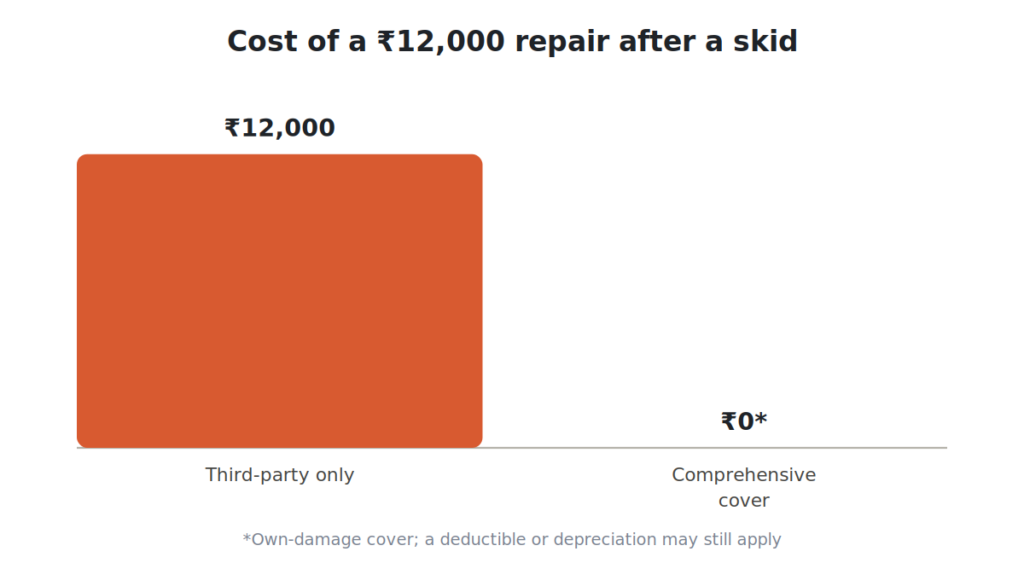
Say your bike’s IDV is ₹60,000 and you skid on a wet road, causing
₹12,000 of damage to the bike. Under a comprehensive policy, the insurer
pays for the repairs after deducting any compulsory deductible and,
unless you have a zero-depreciation add-on, depreciation on replaced
parts. If the bike also hits a parked car, the third-party part of your
policy handles that damage separately.
Under a third-party-only policy, the ₹12,000 for your own bike would
come out of your pocket, while the damage to the other car would still
be covered.
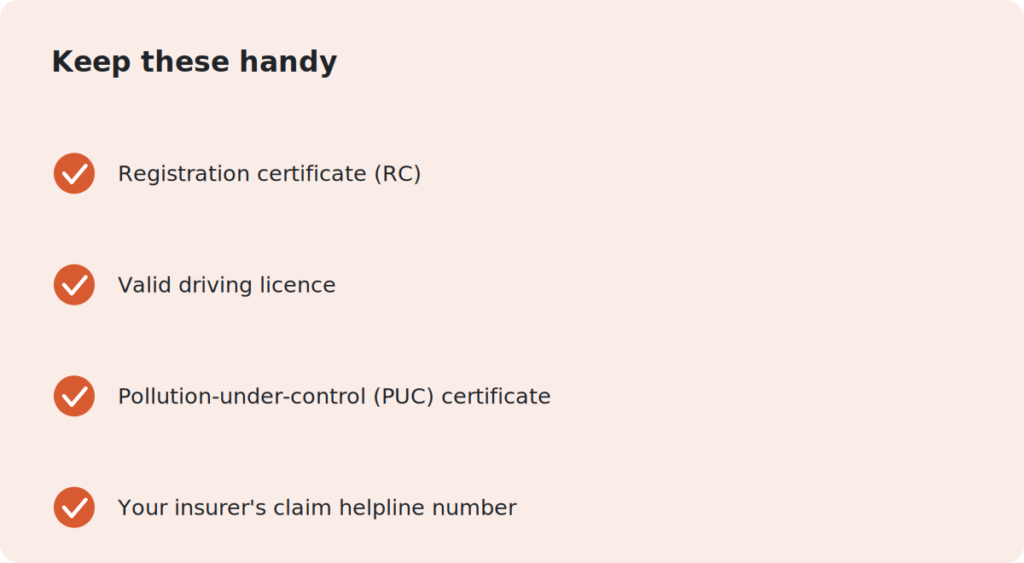
Keep your documents in order
Carry your driving licence, registration certificate (RC), insurance and
pollution-under-control certificate. Digital copies stored in DigiLocker
or the mParivahan app are generally accepted during checks. Keep the
policy number and your insurer’s helpline saved in your phone, and take
photos of your bike after purchase or major repairs. They are useful if
a dispute ever arises.
Common mistakes
Letting the policy lapse, understating the IDV, hiding modifications,
making small claims that wipe out NCB, and buying a policy only because
it is cheapest are the most common. Another is not checking exclusions:
riding without a valid licence, drunk riding and using the bike
commercially without the right policy can all lead to a rejected claim.
Frequently asked questions
Is comprehensive insurance necessary? It is not legally required, but it
is the only way to protect your own bike. For a new or expensive bike,
it is well worth it.
Can I transfer insurance when I sell my bike? The policy can be
transferred to the new owner, but the NCB stays with you and can be used
on your next bike.
What if my bike is stolen? File an FIR, inform your insurer and submit
the documents. Payment is generally based on the IDV.
Key takeaways
Bike insurance is one of the cheapest forms of protection you will buy,
and one of the most useful on the day you need it. Pick a policy that
suits your bike’s value, set a fair IDV, add only the extras you need,
renew on time and keep your documents in order.
Editorial note: Rates, fees, tax rules and regulatory requirements can
change. Check the current terms that apply to you before acting.
Disclaimer: This article is for general information only and is not
financial, tax or legal advice. Rates, fees and rules change, so check
the lender’s or insurer’s current terms and consult a qualified
professional before you decide.
 Life Insurance
 in India: Why Term Plans Come First
 Mutual Funds
 in India: A Beginner’s Guide to Investing Through SIPs
 Business Loan
s in India: How Small Businesses Can Borrow Smartly
 Home Loan
s in India: A Buyer’s Guide to Rates, EMIs and Hidden Costs
 Chit Fund
s in India: How They Work and How to Stay Safe
 Gold Loan
s in India: Quick Cash Against Your Jewellery, Explained
 Health Insurance
 in India: A Practical Guide to Choosing the Right Policy
 Credit Cards
Comments