

Mutual Funds in India: A Beginner’s Guide to Investing Through SIPs
You do not need a large lump sum or a stock-market background to startlearning about mutual funds. A SIP can turn investing into a monthlyhabit, but the important part is knowing what you are…

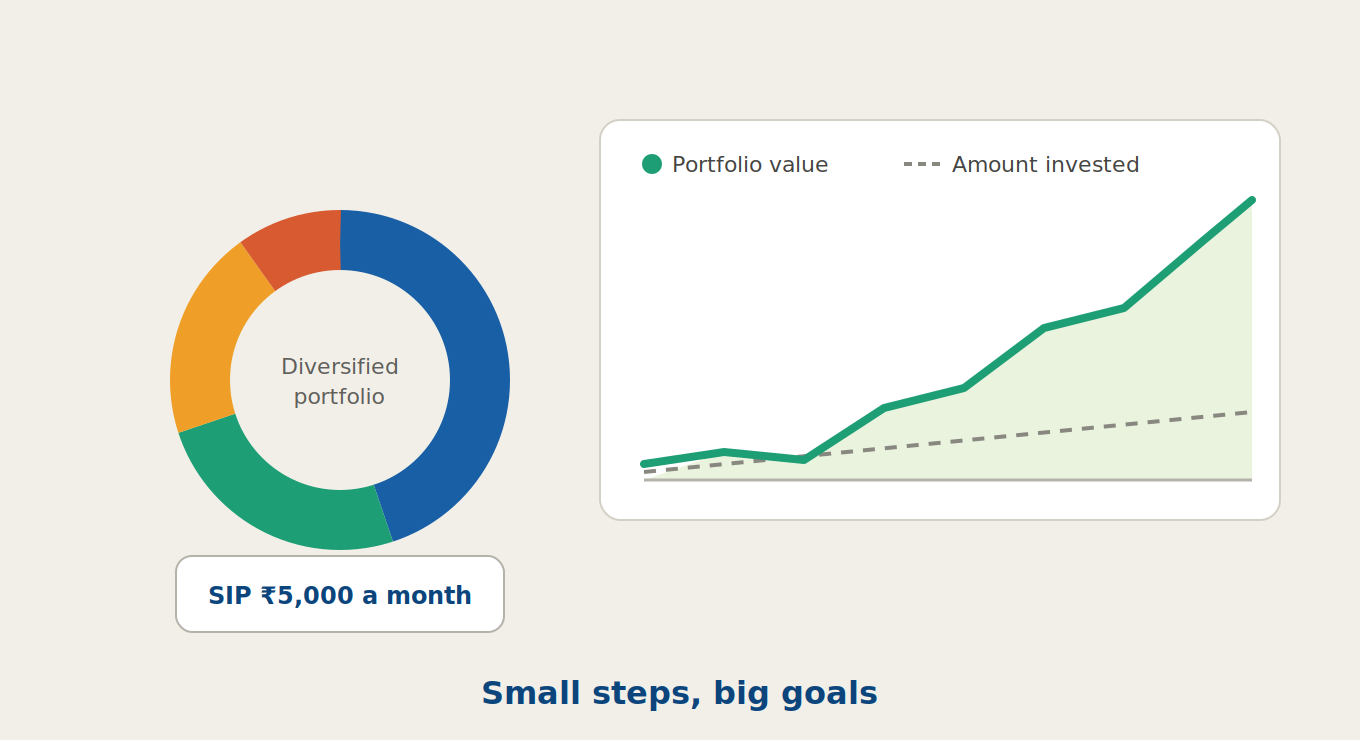
You do not need a large lump sum or a stock-market background to start
learning about mutual funds. A SIP can turn investing into a monthly
habit, but the important part is knowing what you are buying, what level
of risk you can live with and how long the money can stay invested.
Key takeaways
- A mutual fund pools money from many investors and invests it in
shares, bonds or other assets, managed by professionals and
regulated by SEBI. - A Systematic Investment Plan (SIP) lets you invest a fixed amount
every month, starting from as little as ₹100 to ₹500 in many
schemes. - Returns are not guaranteed. Equity funds can fall sharply in the
short term, so match the fund to your time horizon. - Direct plans have lower expense ratios than regular plans, which
adds up over the years.
“A SIP doesn’t need a perfect market, just a consistent one.”
Ask a room of Indian professionals where they invest, and most will say
fixed deposits, gold or real estate. Ask how many use mutual funds, and
hands go up more slowly. Yet mutual funds have become one of the most
accessible ways to build wealth, with monthly SIPs now a habit for
millions of households.
If you are new to it, the jargon can feel like a wall. It is not as
complicated as it looks.
What is a mutual fund?
A mutual fund collects money from many investors and invests it in a
portfolio of shares, bonds, government securities or other assets.
Professional fund managers decide what to buy and sell. You own units of
the fund, and the value of each unit is its Net Asset Value (NAV).
Mutual funds in India are regulated by SEBI, and the fund houses are
called Asset Management Companies (AMCs). The advantages are
diversification (your money is spread across many holdings),
professional management, low starting amounts and easy access to your
money in most open-ended schemes.
The main types of funds
- Equity funds. Invest mainly in shares. They carry higher risk and
have historically offered higher returns over long periods.
Sub-types include large-cap, mid-cap, small-cap, flexi-cap and index
funds. - Debt funds. Invest in bonds and money-market instruments. They aim
for more stability, but they are not risk-free, since interest rate
moves and credit problems can affect returns. - Hybrid funds. A mix of equity and debt in one scheme.
- Index funds and ETFs. Simply track a market index such as the Nifty
50 or Sensex, often at a very low cost. - ELSS. Equity Linked Savings Schemes come with a three-year lock-in
and qualify for a Section 80C deduction (up to ₹1.5 lakh) under the
old tax regime.
SEBI requires every scheme to display a riskometer, from low to very
high risk. Check it before you invest.
What is a SIP?
A SIP is not a product. It is a method. You instruct your bank to invest
a fixed sum, say ₹5,000, in a chosen fund on a set date every month.
When markets are high, your money buys fewer units, and when markets are
low it buys more. Over time this averages out your cost and removes the
pressure of trying to time the market.
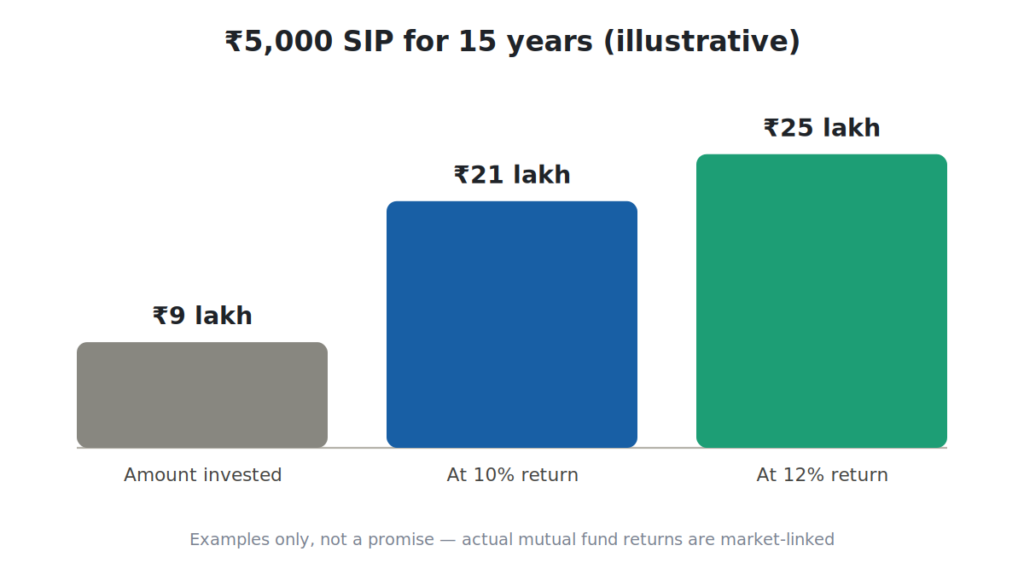
Here is an illustration. Investing ₹5,000 a month for 15 years means
putting in ₹9 lakh. If the fund grew at an assumed 10% a year, that
would become about ₹21 lakh. At an assumed 12%, it would be about ₹25
lakh. These are examples, not promises. Actual returns can be higher,
lower or negative, especially over shorter periods.
Direct vs regular plans
Every scheme comes in two versions. A regular plan pays a commission to
the distributor or advisor, so it has a higher expense ratio. A direct
plan does not, so its expense ratio is lower, often by about 0.5% to 1%
a year. That may sound small, but on a large portfolio over 15 or 20
years the difference compounds into lakhs of rupees.
If you are comfortable choosing funds yourself, direct plans make sense.
If you want a professional to guide you, a fee-only SEBI-registered
investment adviser can be a good alternative to commission-based advice.
How to choose a fund
- Set your goal and time horizon. Money you need in one or two years
should not sit in equity funds. Goals five to seven years or more
away can take more equity. - Know your risk comfort. Ask yourself how you would feel if your
portfolio dropped 20% in a bad year. - Start simple. A low-cost index fund or a flexi-cap fund is a
reasonable core for many beginners. - Check costs. Look at the expense ratio and any exit load, the fee
some funds charge for redeeming early. - Look at consistency, not just last year. A top performer last year
is often not the better pick for the next one. Check long-term
returns compared with the fund’s benchmark and peers. - Do not over-diversify. Three to five well-chosen funds are often
plenty. Ten similar funds just repeat the same holdings.
How to get started
To invest, you need to complete KYC once, using your PAN, Aadhaar and a
bank account. You can then invest through an AMC’s website or app, a
mutual fund platform or your bank. Many platforms let you start a SIP in
minutes. Add a nominee, choose the SIP date after your salary arrives,
and turn on auto-debit.
Taxes in brief
Tax rules change, so check the current position. As of recent rules,
equity fund gains held for up to 12 months are taxed as short-term
capital gains at 20%, while gains on units held longer than 12 months
are taxed at 12.5% on the amount above ₹1.25 lakh in a financial year.
Gains on most debt funds bought after 1 April 2023 are taxed at your
income tax slab rate. Consult a tax professional for your own case.
When to review, and when to leave it alone
Check your portfolio once or twice a year. Review a fund if it trails
its benchmark and peers for several years, if its strategy or manager
changes in a way that no longer suits you, or if your own goals change.
Do not react to a bad month. When you rebalance, remember that selling
can trigger tax, so factor that in.
Common mistakes
- Stopping SIPs when markets fall. Falling markets are when SIPs buy
more units. Stopping defeats the purpose. - Chasing last year’s winners. Past returns do not guarantee future
results. - Investing without an emergency fund. Forced redemptions during a
fall can lock in losses. - Too many funds. Complexity does not equal diversification.
- Checking daily. Equity investing rewards patience. Reviewing once or
twice a year is enough for most people. - Ignoring costs. A slightly higher expense ratio drags on returns
year after year. - Mixing insurance and investment. Keep them separate, and cover
protection needs with a term plan.

Frequently asked questions
How much money do I need to start? Many funds accept SIPs from ₹100 or
₹500 a month. Choose an amount you can maintain through good and bad
months.
Is my money safe in a mutual fund? Funds are regulated, and your money
is held separately from the AMC’s own assets. But safety of the
structure is not safety of returns. The value of your units moves with
the market.
Can I withdraw anytime? Open-ended funds allow withdrawal on any working
day, although exit loads may apply in the early period, and ELSS has a
three-year lock-in.
SIP or lump sum? A SIP suits regular income and reduces timing risk. A
lump sum can work if you have surplus cash and a long horizon, and some
investors spread it over a few months.
Key takeaways
Mutual funds work better as a habit, not a bet. Decide what the money is
for, pick a simple and low-cost fund that matches your time horizon,
automate your SIP and leave it alone. Mutual fund investments are
subject to market risks, so read all scheme-related documents carefully.
Start small, stay consistent and let time do the heavy lifting.
Editorial note: Rates, fees, tax rules and regulatory requirements can
change. Check the current terms that apply to you before acting.
Disclaimer: This article is for general information only and is not
financial, tax or legal advice. Rates, fees and rules change, so check
the lender’s or insurer’s current terms and consult a qualified
professional before you decide.
 Life Insurance
 in India: Why Term Plans Come First
 Bike Insurance
 in India: What Every Two-Wheeler Owner Should Know
 Business Loan
s in India: How Small Businesses Can Borrow Smartly
 Home Loan
s in India: A Buyer’s Guide to Rates, EMIs and Hidden Costs
 Chit Fund
s in India: How They Work and How to Stay Safe
 Gold Loan
s in India: Quick Cash Against Your Jewellery, Explained
 Health Insurance
 in India: A Practical Guide to Choosing the Right Policy
 Credit Cards
Comments