

Chit Funds in India: How They Work and How to Stay Safe
Your neighbour may have been part of a chit for years. A cousin may haveused one to arrange money for a bike or business. In different parts ofIndia you may hear it called a…

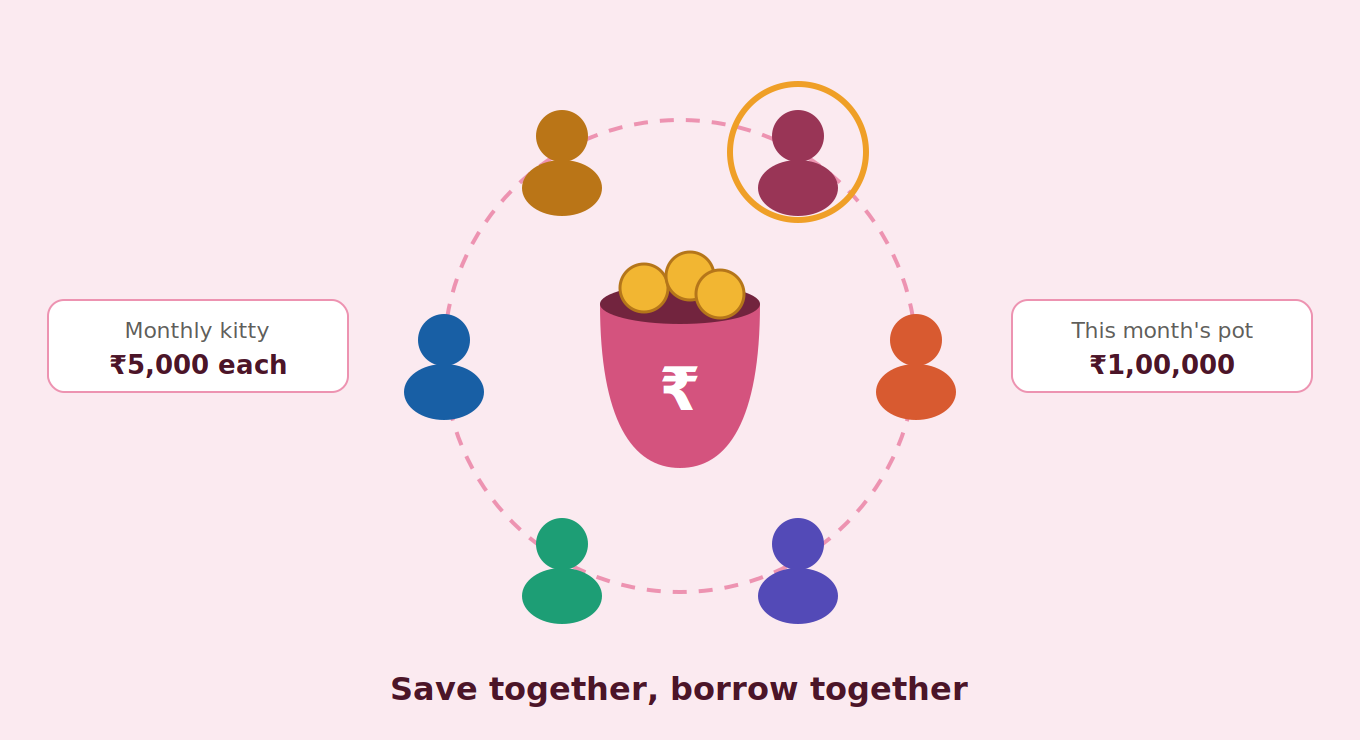
Your neighbour may have been part of a chit for years. A cousin may have
used one to arrange money for a bike or business. In different parts of
India you may hear it called a chit, kuri, chitty or kitty. It is a
familiar way for groups to save and access a lump sum — but the details
matter.
Key takeaways
- A chit fund is a group scheme where members pay a fixed amount every
month and one member collects the pot each month through an auction
or draw. - Registered chits are governed by the Chit Funds Act, 1982 and
supervised by state governments through the Registrar of Chits. - Taking the pot early costs you a discount, so an early win works
like an expensive loan. Waiting works more like savings. - Unregistered chits and anything promising guaranteed high returns
are the biggest risk. Chit funds are not covered by deposit
insurance.
“In a chit fund, patience is its own dividend.”
Your neighbour’s mother has been in a chit for years. Your cousin used
one to buy a bike. A shopkeeper in your street runs one for local
traders. Depending on where you live, it is called a chit fund, a kuri,
a chitty or simply a kitty, and it is one of the oldest ways ordinary
Indian families save and borrow together.
It is also a product that can go badly wrong when people join on trust
alone. Let’s look at how it works and what you should check before
joining.
How a chit fund works
A chit has a fixed number of members, a fixed monthly contribution and a
fixed duration, often equal to the number of members. A “foreman” (an
individual or company) runs the scheme, collects the money and manages
the auctions.
Take a ₹1,00,000 chit with 20 members paying ₹5,000 a month for 20
months. Each month the ₹1,00,000 pot is offered to the members who have
not yet received it. Anyone who wants the money that month bids a
discount: how much of the pot they are willing to give up. The lowest
bid, meaning the biggest discount, wins.
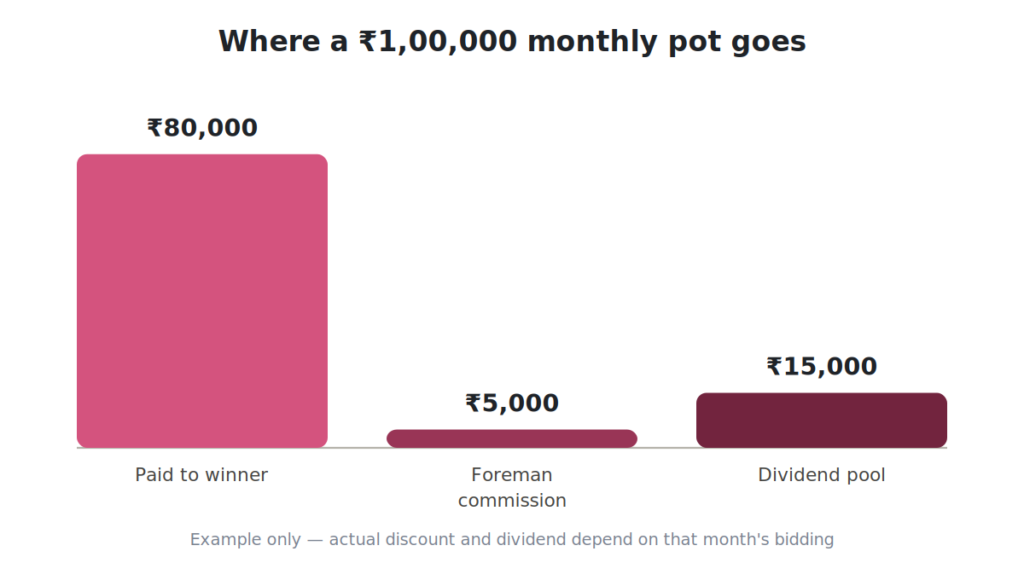
Say the winner bids a discount of ₹20,000. They take home ₹80,000. The
foreman deducts a commission, often capped at 5% of the chit value,
which is ₹5,000. The remaining ₹15,000 is shared among the members as a
dividend, so if it is split equally among all 20, each gets ₹750 and
pays about ₹4,250 for that month. Your chit agreement spells out exactly
who receives the dividend.
This repeats every month. Each member wins the pot exactly once. The
last member often receives close to the full ₹1,00,000, since nobody is
left to bid against.
Two ways to use a chit
As savings. If you wait for the later months, you keep paying your
instalments and benefit from the dividends created by other members’
discounts. Your total return depends on how aggressively others bid, so
it is not guaranteed and can be modest.
As borrowing. If you need cash urgently, you can bid early and give up a
discount. That discount is the cost of borrowing, and it can be steep. A
20% discount for a loan you repay over the remaining months works out to
a much higher yearly rate than a bank loan. Before you bid, compare it
with a personal loan or gold loan.
Many families use a chit as a disciplined saving habit: the monthly
payment feels like a fixed commitment, and that structure keeps them
from spending it elsewhere.
In the example above, a member who takes ₹80,000 gives up ₹20,000 of the
pot’s value but must still keep paying the remaining instalments. That
is the price of getting the money early.
The legal framework
Registered chit funds in India are governed by the Chit Funds Act, 1982,
and each state government makes rules and supervises them through a
Registrar of Chits. Under this system:
- The foreman must register the chit and its agreement with the state.
- The foreman must deposit security and cannot run the chit without
following the prescribed rules. - The foreman’s commission is capped, generally at 5% of the chit
value. - Members who receive the pot may have to provide security or
guarantors, so that the chit can continue if they stop paying. - Disputes can go to the state’s arbitration process.
Chit funds are regulated at the state level, not by RBI or SEBI, and
they are not covered by bank deposit insurance. Schemes that are not
genuine chits, or that promise fixed high returns, can also fall foul of
the Prize Chits and Money Circulation Schemes (Banning) Act, 1978.
The risks
- Foreman failure. If the foreman runs into trouble or disappears,
members can lose their money. - Unregistered chits. These have no legal protection, and disputes are
hard to settle. - Member default. If some members stop paying, the pot can be short,
and the foreman has to recover from the defaulters. - Unclear terms. Confusion about commission, dividends or penalties
leads to arguments. - Poor returns. Compared with a bank fixed deposit, the return from
waiting can be lower, depending on the bids.
How to check a chit before you join
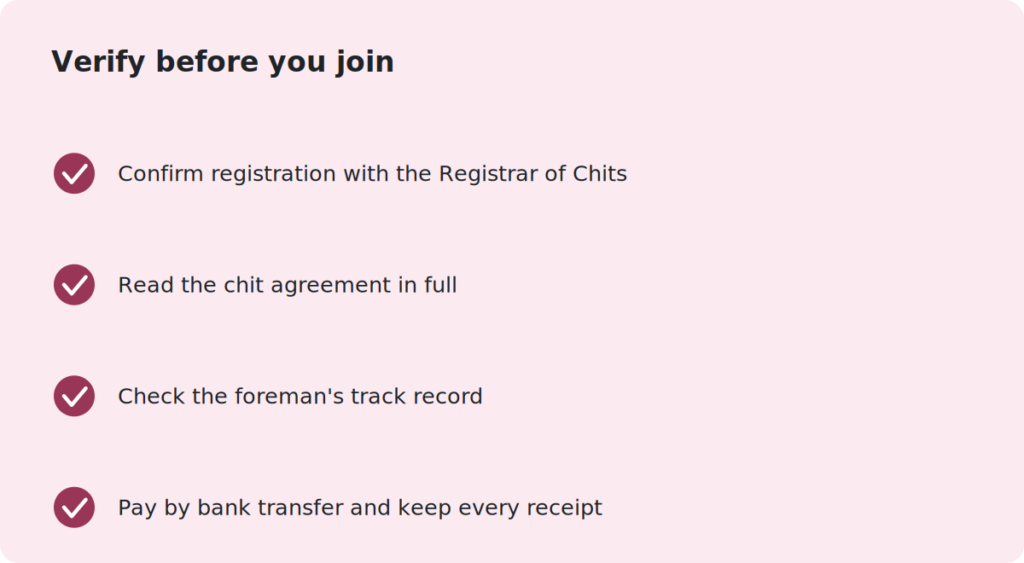
- Verify registration. Ask for the registration details and confirm
them with your state’s Registrar of Chits. - Read the agreement. It should state the chit value, number of
members, duration, auction rules, commission and penalties. - Check the foreman. Look at the foreman’s track record, how long the
business has run and what security has been deposited. - Ask for references. Speak to current or former members.
- Pay by bank transfer or cheque. Keep receipts for every instalment.
Avoid cash-only arrangements. - Be wary of guarantees. No genuine chit promises a fixed high return.
- Understand your exit. Ask what happens if you want to leave, or if
you miss a payment.
Who chit funds suit, and who should skip them
A registered chit can suit people with steady monthly income who want a
forced saving habit, small traders who need occasional lumps of cash,
and families who want a community-based alternative to formal credit. It
also suits people who are comfortable with the auction logic and can
commit for the full period.
If you have irregular income, if you cannot afford to lose the money, or
if you cannot confirm the registration, choose a recurring deposit or a
mutual fund SIP instead. They are regulated, more transparent and, in
the case of bank deposits, insured up to the limits set by law.
Chit fund, recurring deposit or SIP?
A recurring deposit gives a fixed, predictable return and is
bank-backed, with deposit insurance up to ₹5 lakh per depositor per
bank. A mutual fund SIP offers market-linked growth with no fixed
return. A chit offers something neither does: the chance of a lump sum
before you have finished saving, at a price.
If your only goal is to save, an RD or SIP often does it with less risk
and paperwork. If you might need a lump sum in the middle, and you are
confident about a well-run, registered chit, it can play a useful
supporting role rather than being your only savings.
Frequently asked questions
Are chit funds legal? Registered chit funds operating under the Chit
Funds Act, 1982 are legal. Unregistered chits are risky, and schemes
that are not genuine chits may be illegal.
Are the returns guaranteed? No. Returns depend on the auction discounts
and dividends in your particular chit.
Can I leave in the middle? It depends on the agreement. If you have
already won the pot, you often remain responsible for the remaining
instalments. Check the exit terms before you sign.
Is a chit better than a recurring deposit? Not necessarily. A recurring
deposit is simpler and more predictable. A chit offers flexibility and
access to a lump sum, at a variable cost.
Key takeaways
Chit funds endure because they meet a real need: disciplined saving and
credit within a trusted group. The scheme itself is not the problem.
Unregistered, unclear or overpromised versions are. If you decide to
join one, treat it like any other financial commitment: verify the
registration, read the agreement, understand what an early win really
costs and never put in more than you can afford to lose.
Editorial note: Rates, fees, tax rules and regulatory requirements can
change. Check the current terms that apply to you before acting.
Disclaimer: This article is for general information only and is not
financial, tax or legal advice. Rates, fees and rules change, so check
the lender’s or insurer’s current terms and consult a qualified
professional before you decide.
 Life Insurance
 in India: Why Term Plans Come First
 Mutual Funds
 in India: A Beginner’s Guide to Investing Through SIPs
 Bike Insurance
 in India: What Every Two-Wheeler Owner Should Know
 Business Loan
s in India: How Small Businesses Can Borrow Smartly
 Home Loan
s in India: A Buyer’s Guide to Rates, EMIs and Hidden Costs
 Gold Loan
s in India: Quick Cash Against Your Jewellery, Explained
 Health Insurance
 in India: A Practical Guide to Choosing the Right Policy
 Credit Cards
Comments