

Home Loans in India: A Buyer’s Guide to Rates, EMIs and Hidden Costs
Buying a home is exciting until the loan paperwork arrives. Then thenumbers become very real: down payment, EMI, interest, registration anda commitment that may last 15, 20 or even 30 years. A little homeworkbefore…

Buying a home is exciting until the loan paperwork arrives. Then the
numbers become very real: down payment, EMI, interest, registration and
a commitment that may last 15, 20 or even 30 years. A little homework
before signing can make a surprisingly large difference to the total
cost.
Key takeaways
- Home loan rates are often linked to an external benchmark such as
the repo rate, and often fall in a range of roughly 7.5% to 9.5%.
Check current offers. - On a ₹50 lakh loan at 8.5%, cutting the tenure from 20 to 15 years
costs about ₹5,800 more a month but saves roughly ₹15 lakh in
interest. - Budget for the extras: down payment, stamp duty, registration,
processing and legal fees. - RBI rules bar prepayment penalties on floating-rate home loans, so
part-payments are one of your better tools.
“The EMI you can afford in a good month isn’t the EMI to sign up for.”
For most families, buying a home is the biggest financial decision of a
lifetime. The loan that makes it possible can run for 20 or 30 years, so
a small difference in interest rate or tenure turns into lakhs of
rupees. It is worth understanding the loan before you fall in love with
the flat.
How a home loan works
A home loan is a secured loan: the property is pledged to the lender
until you repay. You pay a down payment yourself and borrow the rest,
then repay in EMIs over a tenure that can stretch up to 30 years. Each
EMI has two parts, interest and principal. In the early years, most of
your EMI goes to interest, and the principal falls slowly.
Lenders finance only a share of the property value, called the
loan-to-value ratio. Typically that is up to 90% for smaller loans
(around ₹30 lakh or less), 80% for mid-sized loans and 75% for larger
ones, though you should confirm current limits with your lender. So
expect to fund 10% to 25% of the price from savings.
Understanding the interest rate
Floating rates on home loans are linked to an external benchmark, most
commonly the RBI repo rate. The lender adds a spread to that benchmark
based on your credit profile, loan size and employment. When the
benchmark moves, your rate moves too, and RBI’s framework requires
lenders to tell you about changes and offer options such as adjusting
the tenure, the EMI, or switching to a fixed rate.
Two borrowers at the same bank can pay different rates. A credit score
of 750 or above, stable income and a lower loan-to-value ratio all help
you negotiate a lower spread. Even a difference of 0.25% can matter over
20 years.
The EMI maths, in rupees
Take a ₹50 lakh loan at 8.5%.
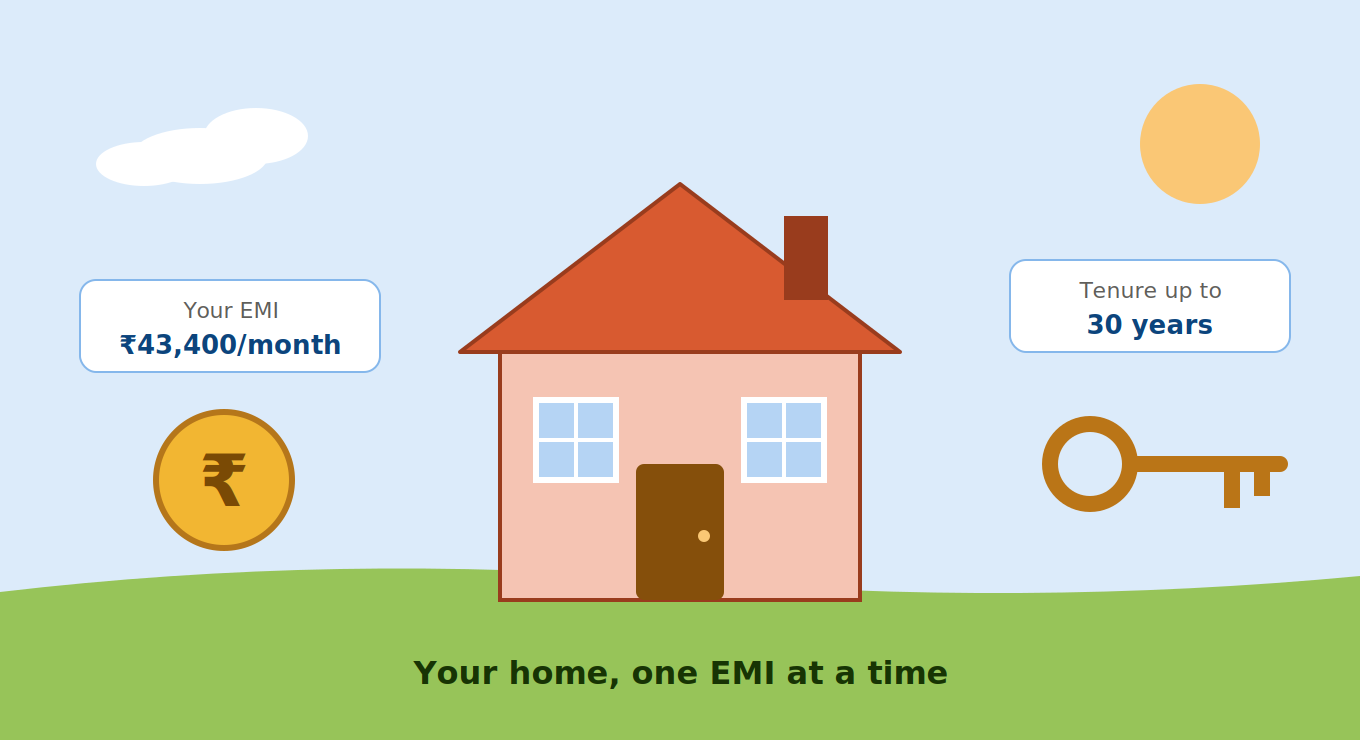
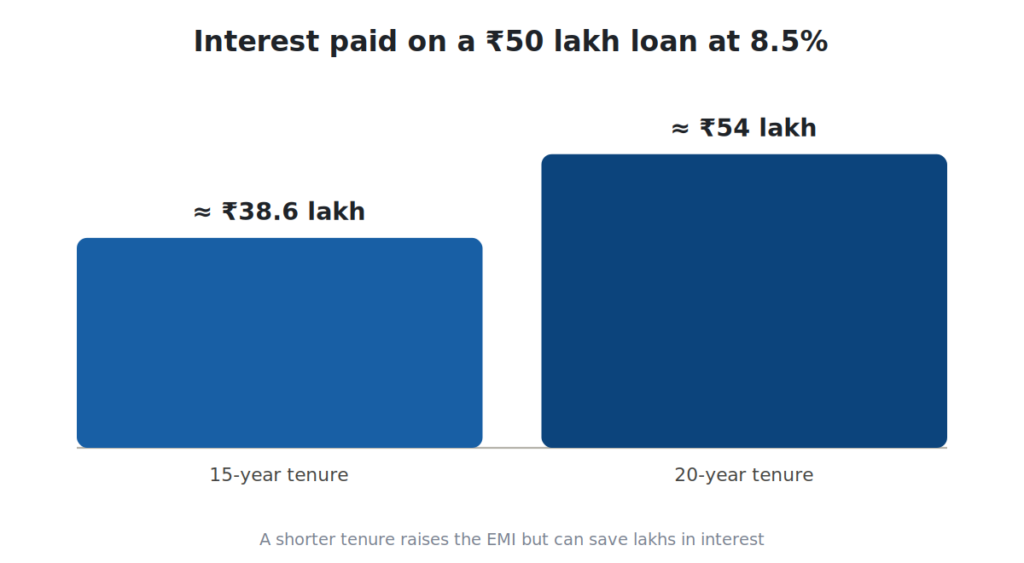
Over 20 years, your EMI is about ₹43,400. You repay roughly ₹1.04 crore
in total, so the interest alone is around ₹54 lakh.
Over 15 years, your EMI rises to about ₹49,200. You repay about ₹88.6
lakh in total, so the interest is around ₹38.6 lakh.
That extra ₹5,800 a month buys you five years of freedom and saves about
₹15 lakh. That does not mean everyone should take 15 years, but that you
should pick the shortest tenure that leaves your budget comfortable.
Many borrowers start with a longer tenure for safety and then prepay
when their income grows.
A quick affordability check
Before you shop, work backwards. Add up your monthly take-home income,
subtract essential expenses and savings goals, and see what EMI is left.
A common guideline is to keep all EMIs within about 40% of take-home
pay, and lower if your income is irregular or you support dependants.
Then test the EMI at a rate one or two percentage points higher, because
floating rates can rise. If it still fits, your budget has room for
surprises.
Who gets a loan, and how much
Lenders judge your repayment capacity using the ratio of your total EMIs
to your income, often wanting it to stay below 40–50%. They check your
credit score, employment stability, existing loans and the property’s
legal and valuation status. Adding a working spouse as a co-applicant
can raise your eligible amount and, in some cases, allows both of you to
claim tax benefits.
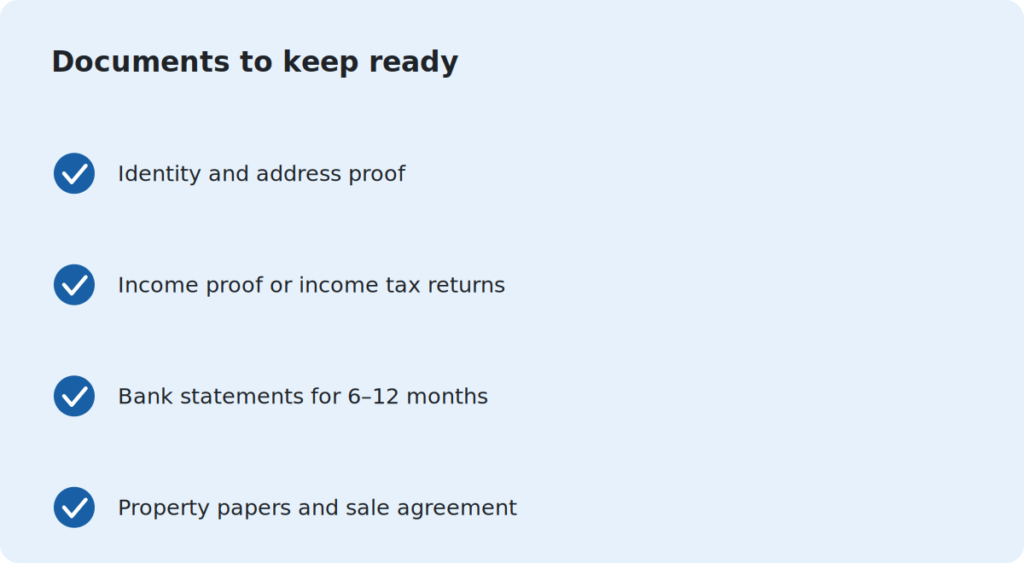
Typical documents include identity and address proof, income proof
(salary slips or income tax returns), bank statements and property
papers.
Costs beyond the EMI
- Down payment. 10% to 25% of the price.
- Stamp duty and registration. Set by each state, often in the range
of 5% to 8% of the property value, and they can be higher in some
cities. - Processing fee. Usually a fraction of a percent of the loan, plus
GST. - Legal and technical valuation fees. Charged for verifying the
property. - Insurance. Some lenders bundle a life or property policy. Check
whether it is optional and compare prices. - Furnishing, maintenance and society charges. Easy to forget, and
they add up.
Prepayment: your quiet superpower
RBI rules bar lenders from charging prepayment penalties on
floating-rate home loans taken by individuals. That makes
part-prepayment one of the useful moves available. Putting a bonus, a
tax refund or a yearly extra EMI towards the principal cuts the interest
sharply, because interest is charged on the outstanding balance. When
you prepay, ask whether to reduce the tenure or the EMI. Reducing the
tenure often saves more interest.
Tax benefits
Under the old tax regime, you can claim a deduction on principal
repayment under Section 80C (within the overall ₹1.5 lakh limit) and on
interest for a self-occupied home under Section 24(b), up to ₹2 lakh a
year. Rules differ for let-out properties and under the new regime, so
check your situation with a tax professional. Some government subsidy
schemes for eligible first-time buyers may also apply.
Buying under construction
If the property is under construction, lenders often release money in
stages as the builder completes work, and you pay only interest (called
pre-EMI) on the amount released until possession. Check that the project
is registered under RERA, that the builder has the required approvals
and that the loan is disbursed against verified progress. Delays can
mean paying rent and pre-EMI at the same time, so plan for that.
Balance transfer and top-up loans
If your rate is well above what new borrowers are offered, ask your
lender to reduce it first, since many will after a request. If they will
not, a balance transfer to another lender can lower the rate, but count
the processing fee, legal charges and the time it takes before the
saving pays off. Many lenders also offer top-up loans on an existing
home loan, often at a lower rate than a personal loan, which can suit a
renovation.
Mistakes to avoid
- Borrowing the maximum you are offered. Eligibility is not
affordability. - Ignoring the spread. Compare the margin over the benchmark, not just
the headline rate. - Never revisiting the loan. If a competitor offers a lower rate, a
balance transfer may save money once you account for fees. - Skipping the emergency fund. Keep several months of EMIs aside
before committing. - Not reading the sanction letter. Confirm every rate, fee and reset
term.
Frequently asked questions
Should I choose a fixed or floating rate? Most home loans are floating.
Fixed rates are often higher and are often fixed only for an initial
period. Floating rates rise and fall with the benchmark, but prepayment
is free.
Can I transfer my loan to another bank? Yes. It is called a balance
transfer. Compare the new rate with the fees before you switch.
What happens if I miss EMIs? You pay penalties, your credit score
suffers, and repeated defaults can lead to recovery action under the
SARFAESI Act.
Key takeaways
A home loan is a long relationship, so treat it like one. Compare
lenders, choose a tenure you can carry comfortably, budget for the
hidden costs and use prepayment when you can. Borrow for the home you
can afford in a bad year, not just a good one, and the loan will be a
stepping stone rather than a weight.
Editorial note: Rates, fees, tax rules and regulatory requirements can
change. Check the current terms that apply to you before acting.
Disclaimer: This article is for general information only and is not
financial, tax or legal advice. Rates, fees and rules change, so check
the lender’s or insurer’s current terms and consult a qualified
professional before you decide.
 Life Insurance
 in India: Why Term Plans Come First
 Mutual Funds
 in India: A Beginner’s Guide to Investing Through SIPs
 Bike Insurance
 in India: What Every Two-Wheeler Owner Should Know
 Business Loan
s in India: How Small Businesses Can Borrow Smartly
 Chit Fund
s in India: How They Work and How to Stay Safe
 Gold Loan
s in India: Quick Cash Against Your Jewellery, Explained
 Health Insurance
 in India: A Practical Guide to Choosing the Right Policy
 Credit Cards
Comments