

Life Insurance in India: Why Term Plans Come First
Life insurance is unusual because the person buying the policy may neverpersonally use the main benefit. The real purpose is to leave financialsupport behind for people who depend on you. Once you look at…

Life insurance is unusual because the person buying the policy may never
personally use the main benefit. The real purpose is to leave financial
support behind for people who depend on you. Once you look at it that
way, the difference between protection and investment products becomes
much easier to understand.
Key takeaways
- Life insurance exists to replace your income for the people who
depend on you. It is protection first, not an investment. - A pure term plan gives the highest cover for the lowest premium.
Endowment and money-back plans often cost far more for the same
cover. - A common rule of thumb is a cover of 10 to 15 times your annual
income, adjusted for loans and dependants. - Disclose your health, habits and income honestly. Non-disclosure is
the most common reason for rejected claims.
“Buy term insurance for what your family needs, not what an agent is
paid to sell.”
Most people buy life insurance the wrong way round. A relative who is an
agent calls at year-end, a tax-saving deadline approaches, or a bank
offers a “guaranteed” plan with your savings account. The result is
often a small cover at a high premium, tied up for decades.
A useful place to start is with one question: if I were not here
tomorrow, what would my family need in order to carry on?
What life insurance really does
You pay a premium. If you die during the policy term, the insurer pays a
lump sum, the sum assured, to your nominee. That money can clear loans,
fund a child’s education and cover household expenses for years. If you
outlive the term, a pure term plan pays nothing, just as your car
insurance pays nothing if you never crash.
The main types of plans
- Term insurance. Pure protection. High cover, low premium, no
maturity payout in most versions. - Whole life. Covers you for life, often up to age 99 or 100. Premiums
are much higher. - Endowment and money-back plans. Combine insurance with a savings
element and pay a maturity benefit. The cover is small relative to
the premium, and the returns often work out to around 4% to 6% a
year. - ULIPs. Unit Linked Insurance Plans invest part of your premium in
market-linked funds. They carry charges and need a long horizon. - Return-of-premium term plans. They give back the premiums you paid
if you survive the term, but at a much higher price than a plain
term plan.
For most people, the simple way to think about it is simple: buy a term
plan for protection, and invest separately through mutual funds, PPF or
other options for wealth.
How much cover do you need?
A quick rule of thumb is 10 to 15 times your annual income. For a more
careful estimate, add up what your family would need:
- Outstanding loans. Home loan, car loan and personal loans.
- Living expenses. Your family’s yearly expenses multiplied by the
number of years they would need support. - Future goals. Children’s education and marriage costs.
- Minus existing assets. Savings, investments and any existing cover.
Remember inflation. A sum that looks large today may be worth much less
in 20 years. Review your cover when you marry, have a child, buy a home
or take on a big loan.
What a term plan costs
Premiums depend on your age, health, smoking status, cover amount and
policy term. As an illustration, a healthy non-smoker in their early 30s
might pay roughly ₹9,000 to ₹15,000 a year for ₹1 crore of cover,
depending on the insurer. Smokers can pay far more, and each year you
wait raises the price.
That is why buying early matters. The premium generally stays fixed for
the entire term.
Choose a policy term that runs until you retire, or until your
dependants are financially independent. Many people pick up to age 60 or
65.
Riders worth a look
- Accidental death benefit. An extra payout if death is caused by an
accident. - Critical illness cover. A lump sum on diagnosis of a listed serious
illness. - Waiver of premium. Future premiums are waived if you become
disabled.
Riders add to the premium, so choose only what you need. Health
insurance often handles medical expenses better than a critical illness
rider.
Choosing an insurer
Look at the claim settlement ratio, which is the share of claims an
insurer settles, along with how quickly claims are paid and how it
handles disputes. IRDAI publishes annual data you can compare. Check the
insurer’s financial strength and the ease of buying and servicing the
policy online. Do not decide on the premium alone, because a policy that
does not pay is worth nothing at any price.
Term plan or endowment: a simple example
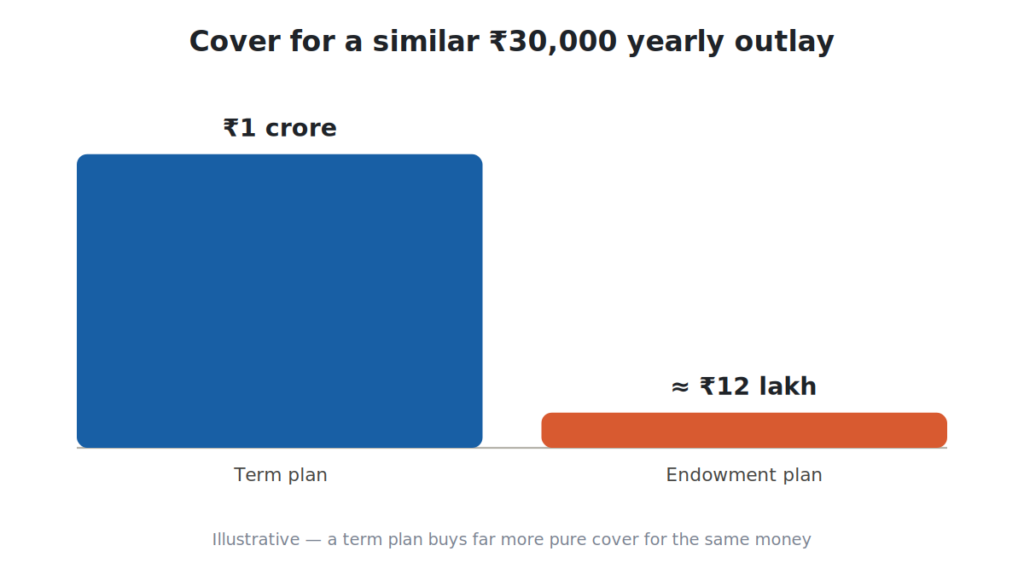
Suppose you can set aside ₹30,000 a year for insurance and savings. A ₹1
crore term plan might cost ₹12,000 of that, and the remaining ₹18,000
could go into a mutual fund SIP. A ₹30,000 endowment plan, on the other
hand, might give a cover of only ₹10 to 15 lakh with a modest maturity
benefit. The first approach protects your family far better and leaves
you in control of your investments. These numbers are illustrations, so
compare real quotes.
Be honest on the form
Insurers ask about your age, health, habits, occupation and income, and
they rely on your answers. If you hide a condition, smoking or a risky
hobby, your family’s claim may be rejected. Under the law, an insurer
generally cannot question a policy on grounds of misstatement after
three years, except in cases of fraud. But relying on that is a gamble.
Tell the truth. A slightly higher premium is much better than a rejected
claim.
Tax rules in brief
Under the old tax regime, premiums qualify for a deduction under Section
80C within the overall limit of ₹1.5 lakh. Death benefits are generally
tax-free for the nominee under Section 10(10D), and maturity proceeds
are tax-free if certain conditions, such as the premium-to-sum-assured
ratio, are met. ULIPs and high-premium policies have special rules. GST
on individual life insurance premiums was removed in September 2025, but
check your quote, since rules change. Confirm the current position with
a tax professional.
How a claim works
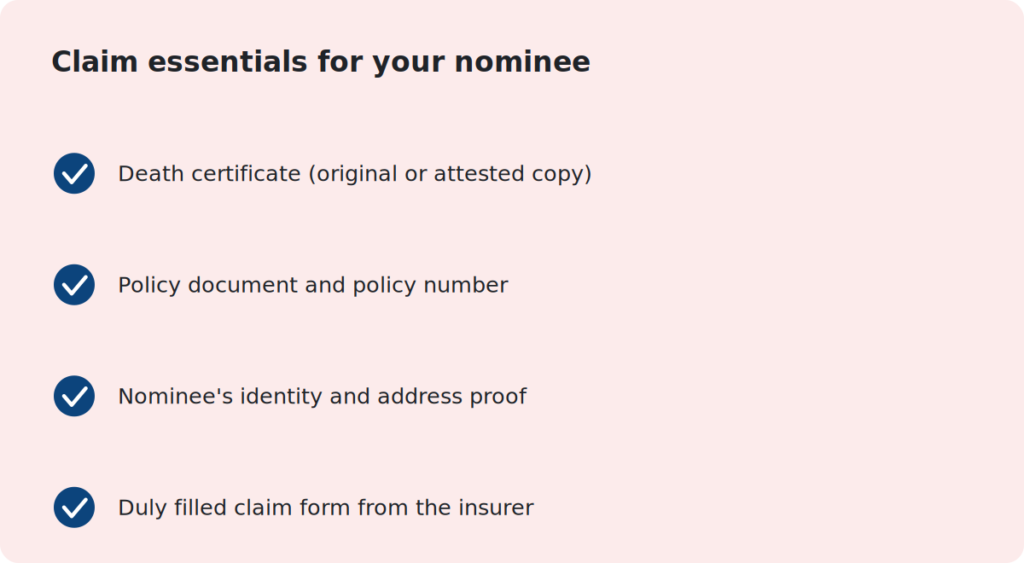
When a policyholder dies, the nominee informs the insurer and submits a
claim form, the death certificate, identity proof and the policy
documents, plus medical or police records where relevant. Insurers may
look more closely at deaths in the first few years of a policy, which is
another reason accurate disclosure matters. Once the claim is approved,
the sum assured is paid to the nominee, and IRDAI rules set time limits
for settlement once documents are complete. Keep the papers in one
folder and make sure your family knows where it is.
Mistakes to avoid
- Treating insurance as an investment. Low returns and low cover are
the usual outcome. - Under-insuring. A ₹10 lakh cover will not last a family long.
- Waiting. Premiums rise with age and health issues can make cover
costlier or harder to get. - Naming no nominee, or an outdated one. Keep the nomination current.
- Not telling your family. They need to know the policy exists, the
insurer’s name and the policy number. - Buying under pressure. Never buy just because of a deadline or a
sales call.
Frequently asked questions
Is term insurance a waste if I survive? No. You bought protection, not a
refund. The peace of mind and the cover for your family were the
product.
Can homemakers or students buy term plans? Options can be limited
without an income, so insurers may restrict cover. A working spouse
often buys the cover, and homemakers may qualify in some cases.
How do I buy one? Compare plans online, fill in accurate details,
complete the medical tests if asked, pay the premium and store the
policy documents safely. Many people also hold policies in an electronic
insurance account for easy access.
Key takeaways
Life insurance is not exciting, and it should not be. Buy a term plan
early, choose a cover that truly replaces your income, disclose
everything honestly and keep investing separately for your goals. It is
one of the few financial decisions where doing the simple thing is also
the right thing, and where your family will feel the difference when it
counts.
Editorial note: Rates, fees, tax rules and regulatory requirements can
change. Check the current terms that apply to you before acting.
Disclaimer: This article is for general information only and is not
financial, tax or legal advice. Rates, fees and rules change, so check
the lender’s or insurer’s current terms and consult a qualified
professional before you decide.
 Mutual Funds
 in India: A Beginner’s Guide to Investing Through SIPs
 Bike Insurance
 in India: What Every Two-Wheeler Owner Should Know
 Business Loan
s in India: How Small Businesses Can Borrow Smartly
 Home Loan
s in India: A Buyer’s Guide to Rates, EMIs and Hidden Costs
 Chit Fund
s in India: How They Work and How to Stay Safe
 Gold Loan
s in India: Quick Cash Against Your Jewellery, Explained
 Health Insurance
 in India: A Practical Guide to Choosing the Right Policy
 Credit Cards
Comments