

Personal Loans in India: What to Know Before You Borrow
Fast, collateral-free and easy to say yes to, a personal loan can rescuea tough month or quietly stretch your budget for years. Before youaccept one, it helps to understand what you are really paying…

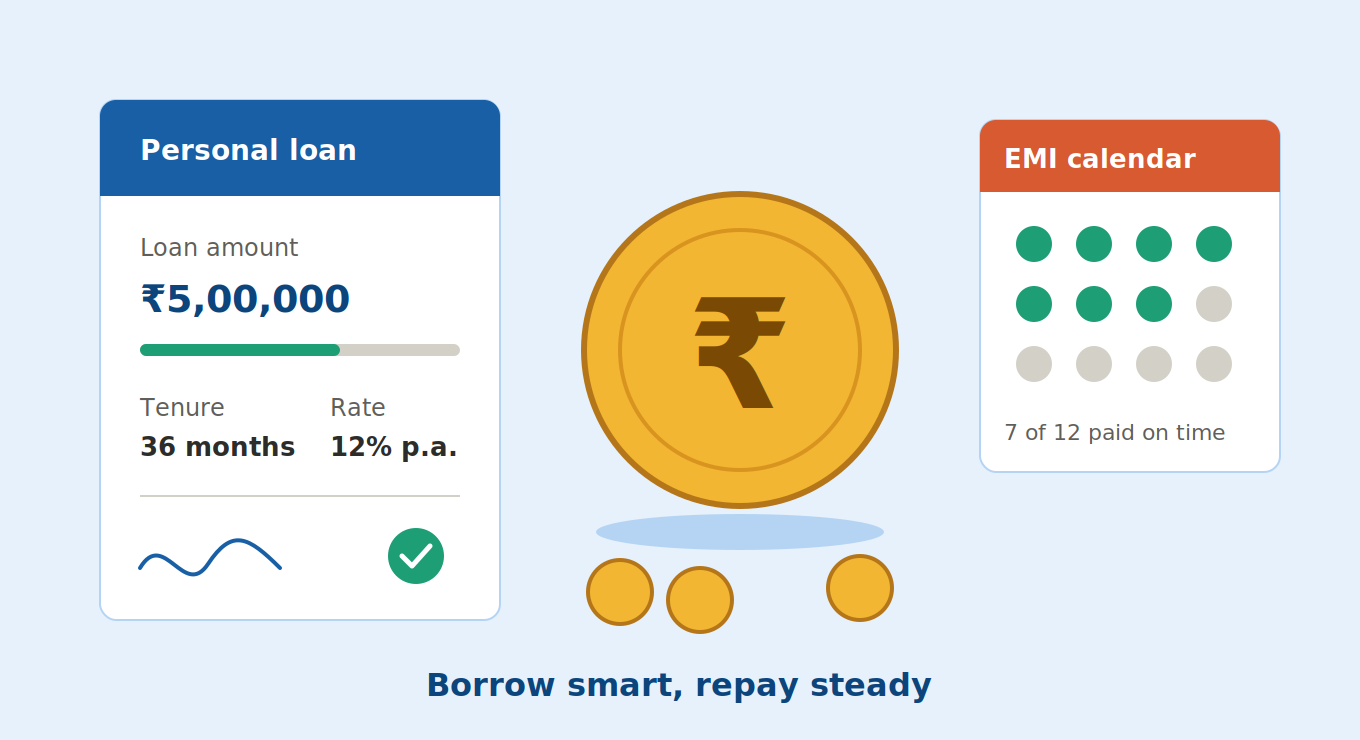
Fast, collateral-free and easy to say yes to, a personal loan can rescue
a tough month or quietly stretch your budget for years. Before you
accept one, it helps to understand what you are really paying for.
Key takeaways
- Personal loans are generally unsecured, so you do not pledge a
house, car or gold as security. - The rate offered to you can depend on income, employment, existing
debt, credit history and the lender’s own assessment. - A lower EMI is not automatically a cheaper loan. A longer tenure can
reduce the monthly payment while increasing the total interest. - Look at the complete cost: interest, processing fee, GST,
late-payment charges, insurance if any, and prepayment or
foreclosure terms. - Borrow for a defined purpose and amount. If the EMI leaves no room
for normal expenses or emergencies, the loan is probably too large
for your budget.
“Borrow for the emergency you have, not the one you’re imagining.”
What a personal loan actually is
A personal loan is money you borrow without pledging an asset as
security. Banks, NBFCs and other regulated lenders may offer them for
expenses such as medical bills, education, a wedding, home improvements
or debt consolidation.
Because the loan is unsecured, the lender is taking more risk than it
would with a secured loan. That is one reason personal-loan rates can be
higher than home or gold-loan rates.
The important thing is not whether a lender says you are eligible. It is
whether the repayment fits comfortably into your monthly life.
How the EMI works
Every EMI has two parts: principal, which reduces what you owe, and
interest, which is the cost of borrowing.
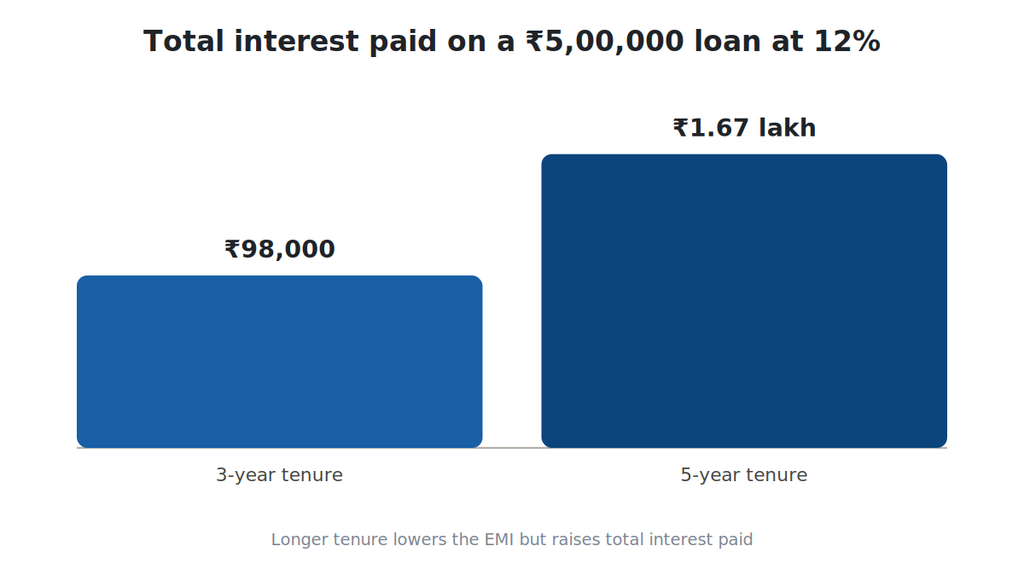
Suppose you borrow ₹5 lakh at an assumed 14% annual interest rate for 3
years. The EMI would be roughly ₹17,100. Over the full tenure, you would
repay about ₹6.16 lakh, meaning roughly ₹1.16 lakh goes towards
interest.
Stretch the same loan to 5 years and the EMI falls to roughly ₹11,600,
but the total interest becomes much higher.
That is why it is worth comparing both the EMI and the total repayment
before choosing a tenure.
What lenders look at
There is no single approval formula used by every lender. Common factors
include:
- Income and how stable it is
- Existing EMIs and other debt
- Employment or business history
- Credit history and repayment record
- Bank-account activity and other documents requested by the lender
- The lender’s internal eligibility rules
A credit score can influence pricing and eligibility, but there is no
universal score at which approval is guaranteed or refused. Different
lenders can make different decisions for the same applicant.
The costs people notice late
The interest rate gets most of the attention, but the loan agreement can
contain several other charges.
Check the processing fee and GST, documentation or verification charges,
late-payment penalties, and any insurance or add-on product included
with the loan. If you expect to repay early, read the foreclosure or
prepayment clause before signing.
Do not compare two loans using the headline rate alone. Compare the
amount you actually receive, the EMI, the total repayment and the full
list of charges.
Before you apply
Start with the amount you genuinely need. If the purpose is a ₹2 lakh
medical expense, borrowing ₹4 lakh because the lender offers it does not
make the situation easier.
Then check your existing EMIs and regular household expenses. Leave room
for rent, food, school fees, travel, insurance and an emergency fund.
It is also worth checking your credit report for errors before making
applications. Apply selectively rather than sending applications to
every lender you see.
When a personal loan can make sense
A personal loan can be useful when the expense is necessary, the amount
is known and the repayment can comfortably fit into your budget.
It can also be considered for consolidating expensive debt, but only if
the new loan genuinely lowers the overall cost and you do not continue
adding fresh debt to the cleared cards or accounts.
When to pause
Be careful if you are borrowing to cover a recurring monthly shortfall.
A loan can solve this month’s gap while creating a new EMI for the next
several months.
The same caution applies when the only reason the loan looks affordable
is a very long tenure or a minimum-payment style calculation.
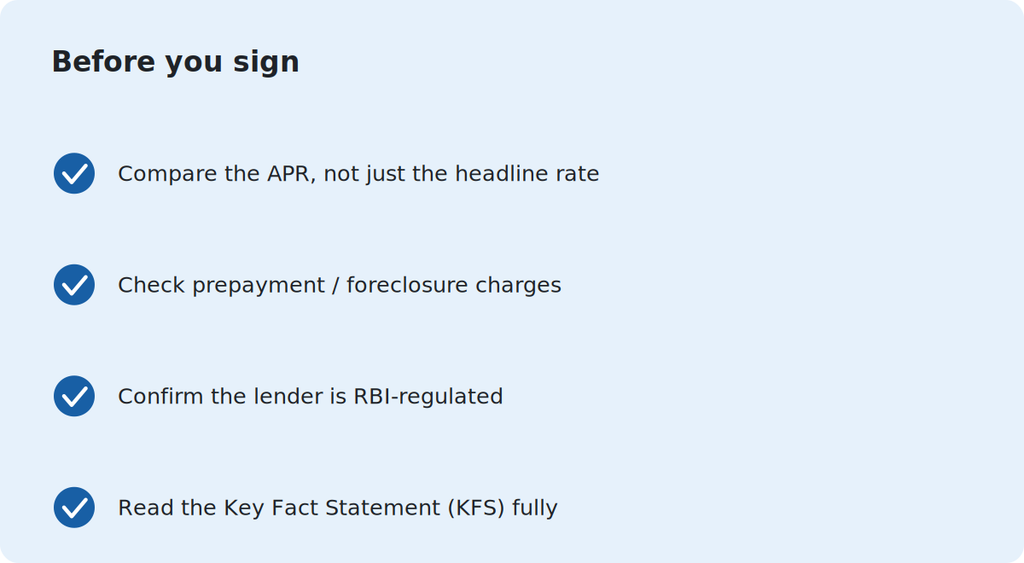
[IMAGE SLOT 3 — CHECKLIST: images/personal-loans-india-guide-checklist.png — “Personal loan quick checklist”]
Frequently asked questions
Is a personal loan always expensive? Not necessarily. Pricing varies by
lender and borrower. Compare the complete cost with other borrowing
options available to you.
Does a higher credit score guarantee approval? No. Credit history is
only one part of a lender’s assessment.
Can I repay a personal loan early? Often yes, but charges and conditions
depend on the loan agreement and applicable rules. Check before signing.
Should I choose a lower EMI or shorter tenure? A shorter tenure
generally means higher monthly payments but less interest overall.
Choose the option that fits your real budget.
What to take away
A personal loan is easy to think of as quick cash. It is better to think
of it as a fixed commitment that follows you every month.
Know the amount you need, compare the complete cost, read the repayment
terms and leave enough breathing room in your budget. The right loan is
not simply the one you can get. It is the one you can repay without
making the rest of your finances fragile.
Editorial note: Rates, fees, eligibility rules and regulatory
requirements can change. Check the current lender terms before acting.
Disclaimer: This article is for general information only and is not
financial, tax or legal advice.
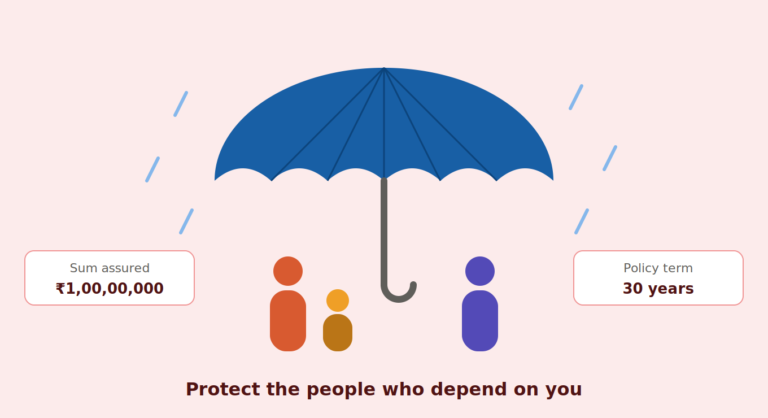 Life Insurance
 in India: Why Term Plans Come First
 Mutual Funds
 in India: A Beginner’s Guide to Investing Through SIPs
 Bike Insurance
 in India: What Every Two-Wheeler Owner Should Know
 Business Loan
s in India: How Small Businesses Can Borrow Smartly
 Home Loan
s in India: A Buyer’s Guide to Rates, EMIs and Hidden Costs
 Chit Fund
s in India: How They Work and How to Stay Safe
 Gold Loan
s in India: Quick Cash Against Your Jewellery, Explained
 Health Insurance
Comments